

SaaS Marketing
Blog
Fractional CMO for Software Companies: A Smart Growth Strategy
If you run a SaaS or software company, you already know this: product alone does not carry growth for long. At some point the referrals slow down, paid spend gets sloppy, pipeline quality drops, and you start to feel the limits of “smart tactics” without real marketing leadership.
That is usually when founders start thinking, “Do I need a CMO?”
Then reality hits. A full-time senior marketing leader is expensive, hard to hire, and risky if you are not 100 percent sure what you actually need from the role yet. This is exactly where a fractional CMO makes sense for a software company.
What Is A Fractional CMO, In Plain English
A fractional CMO is a senior marketing leader who works with your company on a part time or project based basis, but carries the same level of responsibility, ownership, and strategic thinking as a traditional CMO.
You are not buying a few hours of random consulting. You are bringing in an operator who:
Owns your marketing strategy and roadmap
Translates business goals into a clear growth plan
Leads your team, agencies, and freelancers
Holds marketing accountable to revenue and pipeline, not vanity metrics
The difference is simple. Instead of paying for one hundred percent of a CMO’s time, you pay for the fraction you actually need. The role is structured to match your stage, your budget, and your current team.
You get senior-level judgment without taking on a full time executive hire before you are ready.
Why This Model Fits SaaS And Software Companies So Well
Software companies have a very specific set of marketing challenges. Your growth depends on a tight connection between product, positioning, pricing, sales, and customer success. When any of those pieces drift, acquisition and retention both suffer.
A fractional CMO is uniquely suited to this world because the role is built for:
1. SaaS style growth, not one time campaigns
SaaS and software revenue usually depends on recurring subscriptions, expansions, and long term customer value. That means marketing cannot live as a series of disconnected campaigns. You need a leader who thinks in terms of:
Acquisition, activation, and retention across the full funnel
Lead quality, not just lead volume
Pricing, packaging, and positioning that support expansion revenue
How marketing supports product usage and adoption, not just signups
A fractional CMO comes in to architect this system, not just to “run some ads” or “improve SEO”.
2. Fast-moving product and market changes
Software roadmaps change constantly. Features get added, pricing shifts, ICPs evolve, competitors reframe their story. If your marketing cannot keep pace, your story goes stale, even while your product gets better.
Because a fractional CMO is not buried in corporate politics, they can move faster. They can adjust positioning, update messaging, and re focus channels so your marketing stays aligned with what you are actually selling today, not what you launched [insert timeframe] ago.
3. Transitional moments where you feel “between” stages
There are specific points in a SaaS company’s life where the gap between “what got you here” and “what will get you to the next level” becomes painful:
You outgrow founder led or sales led marketing
You have a small marketing team but no senior leader
You are preparing for funding, an exit, or aggressive hiring
You tried hiring a senior marketer and it did not stick
In these in between seasons, a full time CMO can feel premature, but you still need direction. A fractional CMO steps into that gap, sets the strategy, builds the foundation, and helps you decide what permanent leadership you actually need and when.
What A Fractional CMO Actually Does Inside A Software Company
If you are used to hiring agencies or individual contributors, the idea of a fractional executive might feel vague. So let us ground it.
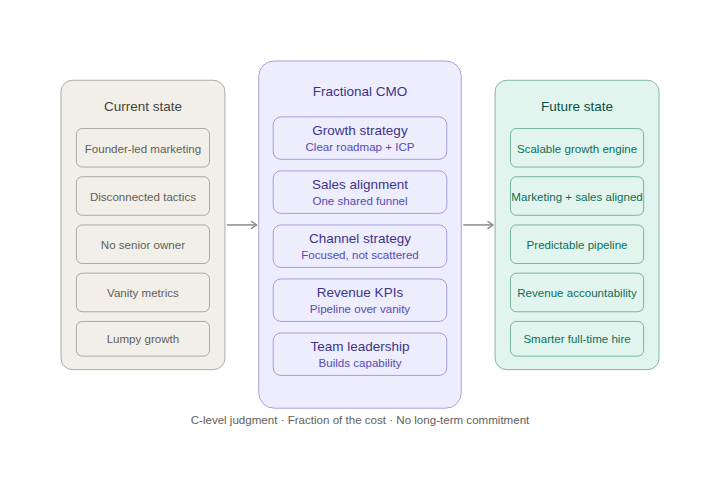
A strong fractional CMO for SaaS will typically:
Clarify your growth goals. Not just “grow MRR” but which segments, which products, which markets, and in what sequence.
Pressure test your ICP and positioning. Make sure your story, audience, and product fit each other, and clean up messaging that confuses buyers.
Build a focused marketing strategy. Decide what you say no to, which channels matter now, and what needs to be tested rather than assumed.
Connect marketing to sales. Align definitions, handoffs, SLAs, and feedback loops so marketing helps close deals instead of tossing random leads over the wall.
Set clear KPIs. Define what “working” looks like at each stage of the funnel, with a simple scoreboard your team can follow.
Lead the team. Provide day to day guidance to marketers, agencies, and contractors so they execute the right plan, in the right order.
You still own the company vision. Your fractional CMO translates that vision into a practical, staged marketing plan that your team can execute without constant reinvention.
Why Founders And CEOs Choose Fractional Over Full Time First
If you are weighing your options, it usually comes down to this question. “Do I invest in a full time CMO now, or bring in a fractional CMO first?”
Here is how many software leaders think through that decision.
Budget and risk. A full time executive is a large, fixed commitment. A fractional CMO gives you senior leadership with a lower fixed cost and more flexibility to adjust as you learn what works.
Clarity. If you are not sure what your ideal marketing org should look like in [insert timeframe] a fractional leader can design it with you, test assumptions, and help you avoid expensive mis hires.
Speed. You can usually bring in a fractional CMO faster than you can run a proper executive search. That matters when you are already feeling growth pains.
The goal is not to avoid a full time CMO forever. The goal is to get the right strategy, structure, and proof points in place so when you do hire, that leader walks into a clear mandate instead of chaos.
If you want to see what a structured outside perspective looks like, you can explore a focused engagement like a SaaS growth audit. It is a practical way to diagnose where your marketing is stalling before you decide how senior your next hire needs to be.
Primary Challenges Faced by SaaS Founders and Software CEOs in Marketing Leadership
If you feel like marketing is the least predictable part of your business, you are not imagining it. Most SaaS and software CEOs I talk to are sharp on product and finance, solid on sales, and frustrated with marketing that feels expensive, noisy, and hard to trust.
Before you fix it, you need to name what is actually broken. For most software companies, the problems cluster into a few patterns.
1. Budget Constraints And High Stakes Hiring Decisions
You probably do not have room in the budget to experiment with executive hires. A senior marketing leader means a significant salary, benefits, equity, and all the hidden costs that come with a leadership role. If that hire misses, you lose time, money, and momentum.
Here is what usually sits underneath the budget tension:
No clear scope. You know you “need marketing” but you are not sure if that means brand, demand gen, product marketing, lifecycle, or all of the above. It is hard to justify a big salary when the role itself is fuzzy.
Fixed cost, variable results. You commit to a full time CMO or VP of Marketing, but the revenue impact takes longer than expected. The cost is immediate. The payoff is not.
Competing priorities. You are weighing a senior marketer against more engineers, another AE, or a key product initiative. Marketing rarely wins that battle without a clear growth story behind it.
So you end up stuck in the middle. Too big for founder led marketing, not quite ready to pour a large chunk of budget into a permanent executive you are not sure you need yet.
That budget tension is real, and you cannot solve it with another paid channel test or a new agency contract.
2. Need For Deep, Specialized SaaS Marketing Expertise
SaaS marketing is not generic “digital marketing”. You are dealing with long sales cycles, multiple stakeholders, complex onboarding, and revenue that depends on retention and expansion, not just net new signups.
When you do not have someone who understands those nuances, a few things happen:
Shallow strategies. You get surface level tactics like “run more webinars” or “produce more content” without a real funnel strategy that connects to ARR, churn, and expansion.
Misaligned messaging. Your copy sounds fine in isolation, but it does not match how your ICP actually evaluates tools, builds internal consensus, or justifies budget.
Channel confusion. You jump between SEO, paid, outbound, partnerships, and product led motions without a point of view about what fits your price point, deal size, and sales model.
The result is predictable. Lots of activity, not much progress. Your team is working hard, but you keep asking, “Why does this not show up in pipeline?”
If your marketing leader has not lived inside a SaaS or software business, they usually underestimate how much coordination it takes between product, marketing, sales, and customer success to create real growth.
3. Scaling Hurdles Between Stages Of Growth
Every stage of a SaaS company’s growth breaks the tactics that worked at the previous stage. The scrappy, improvisational marketing that got you your first meaningful wave of customers rarely scales cleanly.
Here is where founders and CEOs feel the most pain:
Outgrowing founder led marketing. You were the one doing podcasts, conferences, early outbound, and product demos. Now you are out of bandwidth, but you do not have a system that someone else can repeat.
Flatlining channels. One or two channels carried early growth, then plateau. You keep increasing budget or volume, but CAC creeps up and win rates drop.
Fragmented experiments. Every quarter brings a new idea, but nothing is resourced long enough or structured well enough to become a reliable, repeatable engine.
Scaling is not just “more of what worked”. It is a shift from ad hoc wins to a structured growth plan with clear priorities, guardrails, and tradeoffs.
Without a senior marketing leader who has seen those transitions before, you either cling too long to what used to work, or you thrash between new ideas faster than your team can execute.
4. Leadership Gaps During Transition Periods
Software companies go through awkward in between seasons. Those are the times when marketing feels particularly fragile.
Common transition points look like this:
After a senior marketer leaves. You are left with a capable team but no clear leader. Projects slow down, priorities drift, and agencies start calling the shots by default.
During major strategic shifts. You change ICP, adjust pricing, reposition the product, or expand into a new segment. Marketing needs a reset, but the person who can drive that reset is missing.
Pre and post funding events. You raise capital with aggressive growth expectations, but you do not yet have the marketing leadership to deploy that capital with discipline.
In these gaps, founders often try to cover marketing themselves, on top of everything else. That usually leads to two outcomes.
Marketing decisions get made in fragmented, reactive moments.
The team gets busy with projects that make noise but not pipeline.
These transition periods are where a lot of avoidable mistakes show up. Rushed hires, random rebrands, expensive channel bets, and tech stack purchases that no one ends up using.
5. Lack Of Clear Accountability And Measurable Progress
Without strong marketing leadership, you end up with activity metrics instead of business metrics. You are told about impressions, clicks, followers, and “engagement” while you care about net new ARR, expansion, and sales velocity.
Typical symptoms look like this:
No single owner of the funnel. Everyone touches parts of the journey, but no one feels responsible for performance across the whole thing.
Mismatched expectations with sales. Marketing thinks they are crushing it, sales thinks the leads are weak, and you are stuck refereeing.
Reporting that does not drive decisions. You see dashboards and slide decks, but they are not tied to real choices about budget, channels, and focus.
When that is the reality, it is hard to know if marketing is “working” or not. Which means it is hard to justify more investment, even if that investment is exactly what you need to fix the problem.
Marketing should feel as accountable and concrete as sales. If it does not, you do not have a reporting problem, you have a leadership problem.
Where A Fractional CMO Fits Into These Challenges
All of these issues are symptoms of the same root problem, no consistent senior marketing ownership. Not a consultant with a slide deck, not an agency with deliverables, but someone who takes responsibility for decisions, tradeoffs, and results.
If you are reading this and recognizing your own situation, it is worth looking at what a structured engagement with a senior operator could do for you. For some founders, that starts with a focused strategy engagement like a SaaS marketing strategy plan. For others, it means exploring an ongoing fractional CMO model that fits your current stage and budget.
The key is simple. You do not have to keep guessing your way through marketing leadership while carrying the entire risk yourself.
Why a Fractional CMO Is an Effective Solution for Software Companies
You are not short on marketing ideas. You are short on senior judgment that turns those ideas into a focused growth plan without blowing up your budget or locking you into a hire you might regret.
That is exactly where a fractional CMO fits. It is not a watered down CMO role. It is a way to get the same level of thinking, accountability, and leadership, structured to match your stage, your risk tolerance, and your cash flow.
The right fractional CMO gives you C level marketing impact at a fraction of the cost and commitment of a full time executive.
Cost Efficiency Without Sacrificing Senior Leadership
A full time CMO is one of the most expensive hires you can make. Salary, benefits, equity, bonuses, onboarding time, and the hidden cost of a bad fit all stack up fast. For many SaaS companies, that kind of fixed cost is hard to justify until marketing is already a proven growth engine.
A fractional CMO flips that equation.
You pay for the level of leadership, not all of their hours. You get strategic planning, leadership, and decision making, focused into the time your business truly needs, instead of paying for forty plus hours just to justify a title.
You can match investment to stage. Early or mid stage companies can start with a tighter engagement, then scale up scope as the strategy proves itself and revenue grows.
You avoid “learning tax” on a mis hire. If a full time CMO is wrong for your company, you pay for that mistake for a long time. With a fractional engagement, you can test fit, impact, and working style without committing a large, long term budget line.
This is not about being cheap. It is about being disciplined. You channel budget into senior thinking where it matters, and you keep execution work with the team members or agencies who can do it efficiently.
Flexible Engagement Models That Match Your Reality
Your company does not need the same thing every quarter. Sometimes you need heavy strategic support and org design. Sometimes you need light touch guidance while campaigns run. A fractional CMO model can flex with that reality.
Part time leadership. Ideal when you need an ongoing marketing head who owns the plan, runs key meetings, and guides the team, but you do not need or want a full time executive yet.
Project based strategy work. Useful when you need a sharp reset, like a new positioning framework, a focused go to market strategy, or a demand gen plan for a new product line.
Interim coverage. Critical when a senior marketer leaves or you are between leaders. A fractional CMO can keep momentum while you run a proper search instead of rushing into another risky hire.
The point is control. You set the scope, cadence, and focus. As your needs shift, the engagement shifts, without you having to rebuild your leadership team from scratch.
If you want to get a feel for what structured external leadership can look like, starting with a focused session or a free strategy outline, similar to what you would see from a free marketing strategy offer, can be a practical way to pressure test the fit.
Direct Access To High Level Strategic Expertise
Most software companies do not suffer from a lack of activity. They suffer from a lack of a clear, coherent strategy that ties everything to revenue. You might have:
Agencies running isolated campaigns
Internal marketers creating content and assets
Sales pushing for more leads without clarity on quality
What is often missing is the person at the top who can connect those moving parts to a single narrative and a single plan.
A seasoned fractional CMO brings that perspective, especially for SaaS and software. They know how to:
Translate business goals into a staged growth roadmap. Not just “grow ARR” but which ICPs to focus on first, which motions to prioritize, and which channels to ignore for now.
Align product, marketing, and sales. So positioning, messaging, sales decks, and onboarding flows tell the same story and support the same strategy.
Make hard tradeoffs. Stop spreading resources across ten half baked initiatives, and double down on the [insert number] programs most likely to move pipeline and revenue.
You are not hiring for theory. You are buying experienced pattern recognition. Someone who has seen what works in SaaS, what reliably fails, and how to avoid wasting cycles on every shiny tactic that crosses your feed.
Acceleration Without Long Term Commitments
Speed matters. If you feel your growth slowing or your marketing chaos growing, waiting [insert timeframe] to run a full exec search and onboard someone is painful. In that gap, bad habits get baked in and competitors gain ground.
A fractional CMO can step in quickly and start creating structure.
Quick assessment. They can audit your current marketing funnel, ICP definition, messaging, and channel mix, then highlight the [insert number] biggest leaks and opportunities.
Short feedback loops. Instead of annual plans that get outdated fast, you get clear quarterly or monthly priorities, with adjustments based on real performance.
Faster learning. With someone senior designing experiments and reading the data, every test teaches you more, which means you learn faster what works for your product and your audience.
All of that happens without you needing to lock into a long term executive contract. If your needs change, or you decide you are ready for a full time CMO, you are not stuck untangling an arrangement that does not fit anymore.
Bridging The Gap To Your Future Full Time CMO
Most SaaS and software companies will benefit from a strong full time CMO at some point. A fractional CMO does not replace that. They make that future hire smarter and safer.
A good fractional leader will help you:
Define the real role. Instead of a vague “own marketing” mandate, you will know which responsibilities, disciplines, and outcomes your next full time leader needs to own.
Prove what works. With a clear strategy and early wins, you can attract stronger candidates and set realistic expectations for what success looks like.
Avoid structural mistakes. You will build the right foundations, from positioning and ICP clarity to reporting and handoffs, so your future CMO inherits a working system instead of chaos.
Think of a fractional CMO as your bridge from reactive marketing to a serious, revenue focused function.
If you want to go deeper on what that leadership can own for you, resources like a focused fractional CMO for SaaS overview can help you map the gap between where you are and the level of marketing leadership your growth plan actually needs.
Key Responsibilities and Contributions of a Fractional CMO in the Software Industry
A strong fractional CMO does not come in to “give input” on campaigns. They come in to own the entire marketing function, from strategy to execution oversight, with a direct line to revenue.
Let us break down what that actually looks like inside a SaaS or software company so you know what you should expect from the role.
1. Designing A Growth Oriented Marketing Strategy
The first responsibility is simple to describe and hard to do well. Build a clear, focused growth strategy that your team can actually execute.
A capable fractional CMO will typically work through a structured process like this:
Clarify business and revenue goals. Not just “grow ARR” but which products, which segments, which geographies, and what type of deals you want more of.
Stress test your ICP. Confirm who your best customers really are, how they buy, and which segments are distractions. That often means creating a simple ICP hierarchy so everyone knows where to focus first.
Define positioning and narrative. Articulate why you exist, what makes you different, and why your best customers should care now. This becomes the spine for your website, sales decks, and campaigns.
Map the growth levers. Identify the [insert number] levers that matter most, such as inbound demand, outbound, partner channels, product led motions, or expansion. Everything else becomes secondary.
Prioritize initiatives by impact and effort. Build a roadmap that focuses resources on high leverage projects, instead of spreading the team across a long wish list.
The result is a practical marketing plan. Not a glossy slide deck, but a roadmap that says, “Here is what we are doing this quarter, here is why, and here is how we will know if it is working.”
Good strategy is as much about what you say no to as what you say yes to. A fractional CMO gives you that discipline so marketing stops chasing every idea that pops up in Slack.
2. Aligning Sales And Marketing Around One Funnel
If sales and marketing are not aligned, your growth stalls, no matter how smart your campaigns look on paper. A key contribution of a fractional CMO is to turn those two functions into one revenue system.
That usually includes work in areas like:
Shared definitions. Agree on what counts as an MQL, SQL, opportunity, and qualified meeting. No more fuzzy terms that mean different things to each team.
Lead routing and SLAs. Define how fast sales should respond to different lead types, what qualifies for outreach, and what happens to leads that are not ready yet.
Feedback loops. Set up regular sessions where sales shares real buyer objections, stalled deal reasons, and high performing talk tracks. Marketing uses that input to refine messaging and targeting.
Pipeline visibility. Build reporting that both teams trust. If marketing is driving leads but pipeline is not improving, you will see it quickly, and you will know where the breakdown occurs.
The goal is simple. Marketing becomes accountable for pipeline and revenue, not just “leads generated,” and sales stops treating marketing as a disconnected support function.
When sales and marketing share one scoreboard, you get fewer internal arguments and more closed deals.
3. Owning Brand, Positioning, And Story In The Market
In software, your brand is not just your logo or color palette. It is how clearly and consistently you show up in your buyers’ minds. A fractional CMO makes sure that story is sharp, consistent, and aligned with where you want to compete.
That typically includes responsibilities such as:
Positioning strategy. Decide which category you are in, who you stand next to, and what you want to be known for compared to alternatives.
Messaging hierarchy. Create a simple structure that ties together your core promise, key benefits, proof points, and product level messages. This keeps your website, ads, decks, and product screens aligned.
Content themes. Choose a set of strategic content pillars that map to buyer problems and buying stages. This keeps content production focused instead of random.
Guardrails for visual and verbal identity. You do not need a giant brand manual. You do need simple rules that keep your presence consistent across channels.
For crowded or highly competitive markets, this part of the role becomes even more important. If that sounds like your situation, resources such as a focused guide on standing out in saturated markets, similar to what you would see in a dedicated eBook like Standing Out in a Saturated Market, can give you a sense of how a fractional CMO will structure this work.
4. Leading Digital Marketing And Channel Strategy
Most SaaS founders feel overwhelmed by channels. SEO, paid search, paid social, content, email, webinars, affiliates, communities, partner programs, product led loops, outbound, the list never ends.
A fractional CMO’s job is to turn that chaos into a rational channel strategy that matches your ICP, price point, and sales model.
Expect them to take ownership of things like:
Channel selection. Decide which channels deserve focus now, which to test later, and which to ignore, based on your deal size, sales cycle, and buying behavior.
Channel goals and roles. Clarify what each channel is responsible for, such as awareness, lead generation, mid funnel education, or expansion.
Campaign architecture. Design campaigns that connect across channels. For example, search, paid social, and email working together around one core offer, not three disjointed ideas.
Budget allocation. Set and adjust budgets based on performance, instead of “last quarter, plus [insert metric].”
SEO and content direction. Define which topics, keywords, and formats matter for your ICP, and how that content will actually turn into pipeline. If you want to go deeper here, a focused resource like the Fatal Keyword Mistakes guide will give you a feel for the level of rigor a good CMO brings to search and content.
They do not have to write every ad or build every email. But they do own the strategy that ties these pieces into a system that can be measured and improved.
5. Building Scalable Marketing Processes And Infrastructure
A lot of early growth comes from heroics. Individual people pushing hard, improvising, and figuring things out on the fly. That does not scale. One of the most valuable contributions a fractional CMO makes is turning those heroics into repeatable processes.
That usually includes areas like:
Planning rhythms. Setting up quarterly and monthly planning cycles, with clear priorities and owners, so marketing is not reinventing the plan every week.
Standard operating procedures. Creating lightweight playbooks for recurring motions, such as campaign launches, webinar production, content promotion, and sales enablement.
Tool stack clarity. Reviewing your CRM, marketing automation, analytics, and other tools. Keeping what matters, cutting what does not, and making sure the team actually uses what you are paying for.
Data and reporting structure. Defining the handful of KPIs that matter for your stage, then building dashboards that show those numbers clearly, from top of funnel through closed won.
Hiring and org design. Deciding which roles to hire in what order, what to keep in house, what to outsource, and how to structure responsibilities as you grow.
Scalable process is what lets you grow without burning out your team or your budget. A fractional CMO’s job is to build that backbone before you hit the breaking point.
6. Coaching, Leading, And Elevating The Marketing Team
The job is not only strategy. A fractional CMO also needs to show up as a real leader for your existing people, even if they are not in the building full time.
Expect them to contribute in areas such as:
Day to day guidance. Helping individual marketers prioritize their work, understand how their role connects to revenue, and avoid busywork.
Skill development. Spotting gaps in your team’s capabilities and creating simple development plans, such as giving a performance marketer ownership of a test program or having a content marketer own a full campaign.
Agency and vendor management. Setting expectations for agencies, holding them accountable to performance, and cutting or replacing partners who are not delivering.
Cross functional collaboration. Keeping communication tight with product, sales, RevOps, and customer success so marketing is not building in a vacuum.
A good fractional CMO leaves your team stronger and more capable, not more dependent on outside help.
What You Should Hold Your Fractional CMO Accountable For
When you pull all this together, the responsibilities can look complex. You can keep your expectations simple by anchoring on a few core outcomes.
A clear, written growth strategy that aligns with your business goals.
Sales and marketing operating as one funnel, with shared definitions and metrics.
Messaging and positioning that your team can repeat consistently in every channel.
A rational channel strategy with visible performance and clear tradeoffs.
Basic processes and reporting that make marketing predictable and manageable.
A marketing team that knows what to work on, why it matters, and how success is measured.
If you are not getting these outcomes, you do not have a fractional CMO, you have a high priced consultant.
The next step is figuring out how to put this level of leadership to work inside your own company. If you want a more detailed breakdown of how these responsibilities map to your specific situation, booking a focused strategy conversation, similar to what you would get through a dedicated consultation page like Schedule Your Call with Zack, is often the fastest way to see what is missing and what to tackle first.
How SaaS Founders Can Leverage Fractional CMOs To Build A Scalable Growth Plan
Bringing in a fractional CMO is not the win by itself. The win is using that leader to design a growth plan your team can actually run, measure, and scale without constant reinvention.
This section walks through a practical way to do that. Treat it like an operating framework you and your fractional CMO can work through together.
Step 1: Define Clear, Staged Growth Goals
Most SaaS growth conversations start and end with “increase MRR” or “hit [insert metric] in ARR.” That is not specific enough to guide marketing.
With a fractional CMO in the room, you want to translate vague growth targets into a staged, concrete plan.
Segment your growth targets. Decide how much growth you expect from new business, expansion, and retention. Your marketing strategy will look very different if [insert metric] of growth must come from net new customers versus expansion.
Prioritize ICPs. Rank your ideal customer profiles in order of importance. For each ICP, capture simple criteria such as industry, team size, tech stack, and typical buyer roles.
Map growth by timeframe. Agree on what “success” looks like in the next [insert timeframe], then the next one after that. Early stages might focus on pipeline coverage and win rate. Later stages might focus more on expansion and payback period.
Align on constraints. Be explicit about budget, team capacity, and non negotiables. Your fractional CMO needs those constraints to design a realistic plan, not a wish list.
By the end of this step, you should have a short document that says, in plain language, “Here is where growth will come from, here is who we are targeting first, and here is the timeframe we care about.”
If you do not anchor on those decisions, every marketing idea will sound equally valid, and you will drift.
Step 2: Align Product Market Fit With Sharp Messaging
Your product market fit is not a line on a pitch deck. It is a living reality that should drive every word you put in front of buyers.
A good fractional CMO will pressure test and translate that fit into a messaging system your entire company can use.
Clarify “best fit” problems. For each target segment, define the [insert number] core problems your product solves and how your buyers describe them in their own words.
Map value to use cases. Connect each problem to a clear outcome your product delivers. Think in terms of time saved, risk reduced, revenue created, or complexity removed. Keep it specific and concrete.
Build a messaging hierarchy. Create a simple structure that includes:
A primary promise or value statement
[Insert number] key benefits that support that promise
Short proof points for each benefit
Feature level messages that tie back to outcomes
Tailor by persona and stage. Adjust language for different buyer roles and funnel stages. The economic buyer, technical user, and day to day operator need different angles, even if they buy the same product.
This is not a one time copywriting project. Your fractional CMO should treat messaging as an operating asset. It should feed into your website, sales decks, outbound scripts, ads, emails, and product marketing.
If you want more rigor here, resources such as the Free SaaS Marketing Resources library can give you structured templates for building ICPs and messaging hierarchies that plug straight into your fractional CMO’s work.
Step 3: Prioritize Marketing Channels With A Clear Thesis
Most SaaS teams spread themselves across too many channels too early. A fractional CMO’s job is to cut that noise and focus your bets.
Instead of asking “What should we do?” ask your fractional CMO to answer “Why this channel, for this ICP, at this stage?”
Start from buyer behavior. For each ICP, define where they go to research, who they trust, and how they like to evaluate tools. Channels should reflect that reality, not a generic list of “B2B tactics.”
Define the role of each channel. Assign a primary job to each channel such as awareness, demand capture, mid funnel education, or expansion. One channel can play more than one role, but you should know its main job.
Limit active focus. Agree on a maximum number of core channels for the next [insert timeframe]. Everything else belongs in a “parked to test later” list.
Set a testing framework. For channels you have not proven yet, define:
A clear hypothesis, for example, “[Insert ICP] will respond to [insert offer] in [insert channel].”
Budget and time boundaries.
Minimum success criteria, such as cost per qualified opportunity, demo, or trial.
You want a channel strategy that is boring on purpose. A few focused bets, clear expectations, and disciplined testing beats a dozen unconnected experiments every time.
Step 4: Turn The Plan Into A Simple Operating Rhythm
Even smart strategies die without structure. Your fractional CMO should convert the growth plan into a simple, repeatable rhythm your team can run.
At a minimum, you want:
Quarterly planning. One working session where leadership and the fractional CMO set:
[Insert number] primary growth objectives
The specific marketing initiatives tied to each objective
Owners and rough timelines
Monthly focus resets. A brief meeting to check progress, cut or adjust underperforming initiatives, and double down on what is working.
Weekly execution check ins. Short calls led by the fractional CMO where marketers, sales, and key stakeholders review what shipped, what blocked progress, and what is on deck.
Lightweight playbooks. Simple checklists or SOPs for recurring motions like campaign launches, content promotion, and webinar workflows, so execution does not reinvent itself every time.
The key is to keep the system lean enough that people actually use it, but structured enough that you stop managing marketing through scattered messages and emergency meetings.
Step 5: Set KPIs And A Scorecard That Ties To Revenue
If your fractional CMO is not anchoring everything to a simple, revenue linked scorecard, you are leaving value on the table.
Work together to define a small set of KPIs across the funnel. Keep them focused and readable.
Top of funnel. Metrics that show you are attracting the right attention, such as:
Qualified inbound leads by ICP
Traffic or reach to key assets that are designed to convert, not vanity impressions
Middle of funnel. Signals that prospects are progressing, for example:
Conversion rates from lead to qualified meeting, trial, or PQL
Engagement with core education assets that correlate with closed won deals
Bottom of funnel and revenue. Metrics directly tied to growth, such as:
Pipeline created by source or motion
Win rate by segment or channel
Sales cycle length for marketing generated deals
Efficiency metrics. A small set of indicators that track the quality of spend, for example:
Cost per qualified opportunity
Payback period on customer acquisition for key motions
All of this should live in a one page scorecard that you and your fractional CMO review on a regular cadence. No slide decks required. Just the core numbers, trends, and decisions.
If a metric does not drive a decision, it does not belong on the scorecard.
Step 6: Use Your Fractional CMO As A Strategic Filter, Not Just A Strategist
One of the most underrated ways to use a fractional CMO is as a filter. Their job is not only to design the plan. Their job is to protect that plan.
Give them permission to:
Say no to new ideas that do not align with current goals or ICP priorities.
Push back on requests that create work without moving key metrics.
Call out when reporting drifts back to vanity numbers.
Retire channels, messages, or offers that are not performing, even if they are someone’s favorite project.
When you treat your fractional CMO as a strategic filter, you stop drowning in possibilities and start compounding on a small number of proven motions.
If you want to go deeper into what a disciplined, metric driven approach looks like across channels, resources like the SaaS marketing blog can give you detailed breakdowns you and your fractional CMO can adapt to your own funnel.
Step 7: Make The Engagement Self Funding Over Time
A smart fractional CMO will help you structure the work so their fees are tied to clear, measurable improvements.
That does not mean overcomplicating compensation models. It means agreeing up front on:
The growth levers their work should affect first, such as pipeline quality, win rate, or payback period.
The milestones that show progress, for example, “consistent pipeline coverage of [insert metric]” or “stable acquisition cost within [insert metric] range.”
The changes you will make as key KPIs improve, like increasing budget on proven channels or adding specific hires once certain thresholds are hit.
Handled this way, the engagement becomes less about “paying for hours” and more about paying for a structured path to a scalable growth engine.
The real value of a fractional CMO is not a clever strategy document. It is a focused, measurable growth plan your team can run with confidence, quarter after quarter, without you as the founder having to guess your way through marketing leadership anymore.
Engagement Models: How Software Companies Typically Work with Fractional CMOs
The way you structure a fractional CMO engagement matters as much as who you hire. If you get the model wrong, you either underuse them or expect miracles they do not have the time or mandate to deliver.
The good news, you have options. Fractional CMO work usually falls into a handful of clear models that fit different stages of growth and different problems.
Your job is not to guess. Your job is to pick the model that matches where your company is right now, and what you need that leader to own in the next stage.
1. Part Time Ongoing Leadership
This is the closest thing to having a CMO on your leadership team, without the full time cost or long term commitment.
What it looks like
A consistent number of days per week or month dedicated to your company
Ownership of marketing strategy and roadmap
Direct leadership of your marketing team, agencies, and vendors
Regular participation in exec or leadership meetings
Best fit when
You are past the very early stage and have some marketing activity in motion
You have at least a small team or a couple of agencies that need direction
You want a single owner for pipeline and growth, but cannot justify (or do not want) a full time CMO yet
You are ready to commit to a clear growth plan, not one off “strategy sessions”
What you should expect from this model
A written, staged marketing strategy that supports your revenue plan
A quarterly roadmap with clear priorities, owners, and timelines
Alignment between sales and marketing around funnel definitions and goals
Ongoing coaching and performance management for your marketing team
This model works well when you want continuity. You get the same senior operator thinking about your business every week, making adjustments, and carrying responsibility for results.
2. Retainer Based Strategic Advisory
Retainer based work is lighter touch. You are not asking the fractional CMO to run the function day to day. You are using them as a senior advisor and strategic partner.
What it looks like
A set number of hours per month for strategy, reviews, and key meetings
Input on positioning, campaigns, channel focus, and metrics
Access for your team to ask questions and get feedback on plans
Less involvement in managing people and vendors directly
Best fit when
You already have a capable marketing leader, but they have not scaled in SaaS before
You want senior judgment on big decisions without changing your org chart yet
You are between stages and need to recalibrate strategy, not rebuild everything
Your budget supports senior input, but not a heavier leadership commitment
What you should expect from this model
Clear feedback on your current strategy and where it breaks
Structured frameworks for ICPs, messaging, and channel prioritization
Regular reviews of performance with specific adjustments, not vague “thoughts”
Support for your internal leader to grow into a stronger VP or Head of Marketing
This is a smart option if you believe your current team is good, but they are missing pattern recognition from someone who has scaled similar motions before.
3. Project Based Strategic Engagements
Project based models are focused, time bound, and outcome specific. You bring in a fractional CMO to solve a concrete marketing problem, then either roll off or shift to a lighter advisory role.
What it looks like
A defined scope, such as “rebuild our positioning” or “design a demand gen plan for [insert product]”
A clear start and end date
Work broken into structured phases, with deliverables at each stage
Intense involvement for a short period, less (or none) afterward
Common project themes
New positioning and messaging system for a product or the full platform
GTM strategy for entering a new segment or launching a new module
Audit and redesign of your demand generation engine
Marketing and sales alignment reset, including definitions and SLAs
Best fit when
You have a specific, high impact inflection point on the horizon
Your team can execute, but they need a strong plan and clear direction
You want to test fit with a fractional CMO before committing to an ongoing model
What you should expect from this model
Well defined deliverables that your team can use for the next [insert timeframe]
Clear decisions on ICP, messaging, and channel bets
A practical action plan, not just a deck
Knowledge transfer sessions so your team can carry the work forward
If you know your positioning is fuzzy or your growth plan is fragmented, a project based engagement gives you a hard reset without overcommitting. For deep work on topics like SEO keyword strategy in SaaS, a resource such as the Fatal Keyword Mistakes eBook is a good example of the level of structure you should expect inside a focused project.
4. Interim CMO During Leadership Gaps
Interim engagements cover you when a senior marketer leaves or you decide to upgrade the role. The goal is stability and progress while you search for a permanent hire.
What it looks like
The fractional CMO steps in as acting head of marketing
They run the team, manage agencies, and own the plan
They partner with you on defining the future full time role
They often support candidate evaluation for the new hire
Best fit when
Your previous CMO or VP of Marketing has left, or is leaving soon
You have a functioning marketing team that needs direction
You want to run a proper search, not rush into a replacement
You cannot afford a multi month pause in marketing leadership
What you should expect from this model
Continuity of campaigns, reporting, and team routines
Stabilization of priorities, so your team does not scatter
Clarity on what did and did not work in the previous leadership setup
Thoughtful input on the profile, responsibilities, and expectations for your next full time leader
A smart interim engagement leaves your next CMO with a clearer mandate and a cleaner foundation instead of a pile of urgent fires.
5. Hybrid Models Tailored To Your Stage
In practice, many software companies use a hybrid approach. You might start with a project to reset strategy, then move into a lighter retainer for ongoing guidance. Or you might begin with part time leadership that tapers into advisory mode once your new full time hire ramps up.
Common hybrid patterns
Project plus retainer. Deep work for [insert timeframe] to rebuild your growth plan, followed by a lean advisory retainer to keep execution on track.
Interim plus transition support. Acting CMO during your search, then a defined overlap period where your fractional leader onboards and supports the new hire.
Part time leadership that scales down. Heavier involvement while you have no senior marketer, then fewer hours once a strong internal leader is in place.
This flexibility is one of the main advantages of fractional work. You can match intensity and scope to what your business actually needs instead of being stuck with an all or nothing executive hire.
How To Choose The Right Engagement Model For Your Company
If you are unsure where to start, use a simple filter.
If no one truly owns marketing today and you feel like growth decisions bounce between founder, sales, and agencies, a part time leadership or interim CMO model is usually the right call.
If you have a marketing owner but they have never built a SaaS growth engine before, a retainer based advisory model can level them up without disrupting the org.
If you are approaching a clear inflection point such as a new product, segment, or rebrand, a project based engagement is the most focused route.
If you are between leaders and do not want to lose momentum during a search, an interim CMO model gives you continuity and better hiring decisions.
The key question is simple. Do you need someone to own marketing, or to advise the person who owns it? Your answer to that question usually points straight to the right model.
If you are in a crowded or competitive software category and feeling pressure to sharpen how you show up in the market, it can be helpful to see how structured positioning work is done. A resource like the Standing Out in a Saturated Market eBook is a useful reference point for the type of clarity a good fractional CMO should produce, whatever engagement model you choose.
Selecting the Right Fractional CMO for Your Software Company
Hiring the wrong fractional CMO wastes money and, more importantly, time you do not get back. You are not looking for a clever marketer. You are looking for a senior operator who understands SaaS, can lead people, and fits how you actually run the company.
Use this section as a practical checklist. If a candidate cannot clear these bars, keep looking.
1. Depth Of SaaS And Software Experience
If they have not lived in a software business, you will be paying them to learn on your dime.
You want someone who understands how subscription revenue really behaves, not just how to run generic digital campaigns.
Look for signals like:
Direct experience with SaaS models. They should be fluent in concepts like MRR, expansion, churn, payback period, and pipeline coverage, and how marketing influences each one.
Exposure to your type of sales motion. Ask whether they have worked with:
Product led growth motions
Sales led mid market or enterprise deals
Hybrid models that mix self serve and sales
Stage familiarity. You want experience that matches your stage. For instance, early stage, growth stage, or more mature orgs with larger teams and more stakeholders.
Comfort with complex buyer journeys. They should be able to talk through multi stakeholder deals, long evaluation cycles, and how marketing supports champions inside prospect accounts.
When you talk to them, listen to how they describe past work. Do they anchor on channels and tactics, or on revenue dynamics, lifecycle, and the realities of selling software?
2. Real Understanding Of SaaS Business Models
A strong fractional CMO thinks like a revenue leader, not just a marketer.
Probe for how they think about the mechanics of your business model.
Pricing and packaging. Can they discuss how pricing structure, tiers, and packaging influence acquisition, expansion, and retention?
Unit economics. They do not need to be your CFO, but they should care about CAC, LTV, and payback windows when recommending channels or campaigns.
Product usage as a growth lever. Good SaaS marketers understand that activation, onboarding, and feature adoption are part of the growth story, not just product’s problem.
Cross functional tradeoffs. Ask how they have navigated situations where product priorities, sales requests, and marketing capacity did not line up. Their answer will tell you how they think about the whole machine, not just their lane.
Red flag. If they talk about success mainly in terms of clicks, impressions, or “brand awareness” without connecting back to revenue, walk away.
3. Proven Leadership Skills, Not Just Tactical Skills
You are not hiring a senior individual contributor. You are hiring someone to lead your marketing function, even if they are fractional.
Test for leadership in a few areas.
Team leadership. Ask how they structure a small marketing team in a SaaS company. Listen for clear role definitions, ownership, and how they prevent overlap and chaos.
Sales partnership. A good fractional CMO should have a clear process for aligning with sales leadership. Ask what they do in the first [insert timeframe] to build that partnership.
Decision making under constraints. Have them walk you through a situation where they had limited budget and headcount, but ambitious targets. What did they prioritize and why?
Conflict handling. Get them talking about a time sales and marketing disagreed on lead quality or messaging. How did they handle it, and what changed afterward?
You are looking for calm, specific answers, not theory. Strong leaders talk in terms of clear choices, tradeoffs, and outcomes, even when they keep things high level.
4. Adaptability To Your Stage And Pace
Your needs today will not look exactly like your needs [insert timeframe] from now. The right fractional CMO can adapt as you grow or as priorities shift.
Gauge adaptability with questions like:
“How do you approach the first [insert timeframe] with a new client?” You want to hear about structured discovery, quick wins, and a clear plan, not just “I get to know the team and see what is going on.”
“How do you adjust when the company’s strategy changes?” Listen for how they re evaluate ICPs, messaging, and channels, and how they communicate those shifts to the team.
“What do you do when the data proves your original thesis was off?” Good operators talk about how they kill or refocus initiatives, not how they defend them.
Look for someone who is structured but not rigid. They should bring a clear framework, while staying comfortable with the reality that software roadmaps and go to market priorities change.
5. Strong Cultural And Working Style Fit
Skill fit without cultural fit is expensive friction. Your fractional CMO interacts with your leaders, your marketers, your sales team, and sometimes your board. Their style has to match how you operate.
Consider factors such as:
Communication style. Do they speak in clear, plain language, or do they fall back on buzzwords and vague phrases? Your team needs to understand them without a translator.
Operating cadence. Ask how often they expect to meet with you, with sales, and with the marketing team. Make sure that cadence matches your expectations and calendar reality.
Bias toward action vs analysis. You want someone who can design a strategy, then move into testing and iteration, not stay stuck in planning mode forever.
Values and attitude. Do they talk with respect about previous teams and leaders? Or do they position themselves as the hero who fixed everyone else’s mistakes?
Culture fit is not about finding someone identical to you. It is about choosing someone who can challenge your thinking without clashing with your core values or burning your team out.
6. Clear Approach, Frameworks, And Expectations
You should never have to guess how a fractional CMO plans to work with you. If they cannot explain their process, you will end up in a vague, deliverable free engagement that feels like expensive consulting.
Ask them to walk you through:
Their discovery process. How they learn your business, customers, product, and numbers in the first [insert timeframe].
How they build a marketing strategy. Look for mention of ICP definition, positioning, channel selection, and clear prioritization.
How they handle measurement. They should have an opinion on which KPIs matter for your stage and how to set up simple reporting that people actually use.
How they integrate with your team. Ask who they will work with day to day, how decisions will get made, and how they will communicate progress.
Push for specifics. You are not looking for their proprietary slides. You are looking for signs they run a repeatable process instead of winging it every time.
7. Alignment On Scope, Authority, And Boundaries
Even the right person will fail in the wrong setup. Before you sign anything, you need alignment on what they own, what they influence, and what sits outside their lane.
Clarify together:
Scope of responsibility. Are they owning the full marketing function, or focusing on specific areas like demand gen or positioning? Spell it out.
Decision rights. Can they make final calls on budget allocation, channels, and priorities, or are they recommending while you or another leader approves?
Time commitment. Be honest about what your company needs. A tiny engagement cannot carry the expectations of a near full time CMO.
Success criteria. Align on what “good” looks like in the first [insert timeframe]. Think in terms of clarity, structure, and leading indicators, not just revenue, since big revenue shifts often lag.
If a candidate hesitates to define scope or success, that is a problem. You want someone who is comfortable being held accountable for a clear set of outcomes.
8. A Simple Evaluation Framework You Can Reuse
To make this concrete, use a straightforward scorecard when you talk with fractional CMO candidates. Rate each candidate on a simple scale, for each of these categories:
SaaS and software experience
Understanding of your specific business model and motion
Leadership and decision making strength
Adaptability to your stage and change tolerance
Cultural and communication fit
Clarity of process and frameworks
Alignment on scope and authority
Pick the person who is strong across the board, not just loud in the interview.
The right fractional CMO will feel less like a vendor and more like a part time co owner of your growth function. When you find that fit, the engagement stops being a cost line and starts functioning like a leverage point for your entire go to market.
Integrating a Fractional CMO with Your Existing Team and Processes
A fractional CMO only works if your team can actually follow their lead. You are not just “adding a consultant.” You are inserting a senior operator into a system that already has habits, tools, and politics.
Handled well, your fractional CMO becomes the clear owner of marketing, even without a full time presence. Handled poorly, they turn into another voice with opinions that nobody has time to implement.
Let us walk through how to set this up so your team, your processes, and your new leader actually click.
Step 1: Give Them a Real Seat at the Table
If you want a fractional CMO to lead, they have to be treated as part of leadership, not as an outsourced vendor.
That starts with access and context.
Loop them into key leadership meetings. They should hear product, sales, and finance conversations directly, not as secondhand summaries.
Share the real numbers. Pipeline, churn, expansion, payback windows, sales velocity, unit economics. If you hide data, you cut their legs out from under them.
Clarify reporting lines. Decide who they report to, usually the CEO or a CRO. Your team should know that this person speaks with that level of authority.
Announce the role properly. Do an internal kickoff where you explain why you brought them in, what they will own, and how success will be measured.
If you treat your fractional CMO like an agency contact, your team will too. Give them the same strategic seat a full time CMO would have, even if the hours are limited.
Step 2: Define Clear Ownership and Boundaries
Marketing already has inertia. People own channels, agencies own deliverables, sales has expectations. If you drop in a fractional CMO without clear scope, you create confusion and turf battles.
Solve that up front.
Document what they own outright. For example, overall marketing strategy, channel mix, budget allocation, messaging framework, quarterly roadmap.
Document where they are an advisor. Maybe pricing, product roadmap, or sales compensation. They give input, but do not make the final call.
Document what is out of scope. For instance, hands on campaign execution, daily community management, or SDR coaching. Your team needs to know where they still carry the ball.
Align with sales and product leadership. Have direct conversations about who decides what. Clarify where alignment is mandatory and where healthy debate is expected.
This might feel basic, but it avoids the common pattern where everyone assumes someone else is in charge, and then nothing moves.
Step 3: Build a Simple Communication Operating System
Your fractional CMO is not in the building every day. That is fine, as long as you have a tight communication rhythm that keeps decisions flowing.
Set up a light but consistent structure.
Standing weekly meeting with marketing. A short, focused call owned by the fractional CMO that covers:
What shipped last week
What is shipping this week
Blockers the team needs help clearing
Regular touchpoint with sales leadership. Often weekly or biweekly. Cover lead quality, pipeline by source, objections from the field, and upcoming campaigns.
Monthly check in with the CEO or founder. Keep this focused on progress against the growth plan, key decisions, and tradeoffs, not a tour of every active task.
Shared async channels. Use one primary place for ongoing discussions, such as a dedicated Slack channel or similar. Avoid scattering decisions across direct messages and random threads.
The goal is simple. Make it obvious where questions go, where decisions get made, and when those conversations happen. That is how you compensate for not having a full time CMO walking the halls.
Step 4: Use the Right Tools to Extend Their Presence
Tools will not fix strategy, but they do matter for a fractional relationship. You are trying to create the feeling of ongoing leadership inside a limited time window.
Think in terms of three core tool buckets.
Communication tools. Chat and video tools are your default. Make sure your fractional CMO has:
Access to key channels with marketing, sales, and product
A clear place for leadership level discussions, separate from day to day noise
Project and task management. Give them access to the system your team already uses, whether that is a project board or a task platform. The fractional CMO should:
See the work tied to the marketing roadmap
Comment, prioritize, and reorder tasks as needed
Review progress without chasing updates in meetings
Data and reporting tools. Make sure they can see:
Your CRM and basic pipeline views
Your marketing automation or email platform
Your analytics dashboards for traffic, conversions, and campaigns
The tech stack does not have to be fancy. It just has to be shared. Your fractional CMO should be able to log in, see the state of play, and make decisions without waiting for someone to pull a report.
Step 5: Reorient Your Team Around One Plan
Most marketing teams accumulate projects over time. Everyone has their own list, based on past requests, pet ideas, and legacy campaigns. When a fractional CMO arrives with a new strategy, that entire pile needs a reset.
Run a structured reset together.
Inventory all active projects. Campaigns, content series, experiments, events, experiments in specific channels. Put everything on one list.
Map projects to the new strategy. For each item, mark whether it directly supports a current objective or not. Use simple tags like “Core,” “Nice to have,” or “Kill.”
Kill or park misaligned work. If something does not support the agreed plan, stop it or move it to a backlog with a clear note: not active now.
Reassign ownership. For each remaining initiative, confirm a single owner, clear scope, and basic timeline. Your fractional CMO should drive this conversation, not just observe.
This is where leadership becomes real. Your fractional CMO is not just writing strategy documents. They are helping you make hard calls about what to stop doing so the team can focus.
Step 6: Align Stakeholders So Marketing Stops Working in a Vacuum
Integrating a fractional CMO is not only a marketing project. It is a cross functional shift. Sales, product, RevOps, and customer success all need to understand how this new leader fits into their world.
Set up a short alignment plan.
Sales alignment session. Cover:
New or refined ICP definitions
Lead definitions and handoff expectations
Upcoming campaigns, offers, and messages
How sales feedback will be captured and used
Product alignment session. Cover:
Roadmap priorities for the next [insert timeframe]
Key releases marketing needs to support
How customer and market insight will flow back into product decisions
Customer success or support alignment. Cover:
Expansion and retention goals
Moments in the customer journey that marketing can support
How voice of customer insights will inform messaging
The goal is not a long workshop series. You just want everyone to know how this person works, what they care about, and how collaboration will actually happen.
Step 7: Make Decision Making and Escalations Crystal Clear
A fractional CMO has limited time. If they spend half of it chasing clarifications or fighting through unclear approvals, you waste the value you are paying for.
Put a simple decision protocol in place.
Define fast track decisions. For example, your fractional CMO can make on the spot calls about creative, messaging, and budget shifts within a set range, without extra approval.
Define shared decisions. Identify a small set of choices that require CEO or sales sign off, such as major rebrands, big budget reallocations, or big shifts in ICP.
Agree on escalation paths. If something is blocked, everyone should know:
Who has the authority to unstick it
Where that conversation happens
How quickly a decision will be made
Time box debates. If a decision is stuck in back and forth for too long, your fractional CMO or CEO calls time and decides. Leaving decisions open kills momentum.
Speed beats perfection in marketing. Clear rules about who decides what let your fractional CMO move quickly without stepping on landmines.
Step 8: Adjust Your Processes to Their Presence, Not the Other Way Around
You hired a fractional CMO for their way of operating. If you ask them to fit into a broken process without change, you just put a sharper person on a bad system.
Work together to tune your processes.
Planning cadence. Your fractional CMO will probably introduce a more structured quarterly and monthly planning rhythm. Give that room to replace the ad hoc planning you have today.
Briefs and approvals. Expect them to standardize how projects get briefed and approved. This keeps them from re answering the same questions and helps your team know what “good” looks like.
Reporting rhythm. You may move from chaotic, sporadic reports to a simple, repeating scorecard review. Commit to that rhythm instead of asking for random reports on top of it.
Agency management. If you work with agencies, let your fractional CMO take point on how they are briefed, measured, and directed. Too many voices confuse vendors and waste spend.
The goal is not to rebuild every process at once. It is to let your fractional CMO clean up the few that matter most for execution speed and clarity.
Step 9: Set Early Wins That Build Trust on All Sides
Your team will judge the fractional CMO quickly. If the first [insert timeframe] feels like endless discovery and no visible changes, people stop paying attention.
Plan for some early, tangible wins.
Pick one or two high impact, low friction moves. For example, tightening lead definitions with sales, cleaning up the homepage headline, or killing a dead channel that drains budget.
Make those wins visible. Share before and after states. Show how a simple change improved clarity or freed budget for better bets.
Use wins to reinforce new behavior. Tie each early win back to the new way of working. For instance, “We made this change quickly because we have one shared funnel definition now.”
Trust comes from seeing smart decisions, not hearing smart ideas. Early wins are proof to your team that this leader is worth following.
Step 10: Review and Tune the Integration Regularly
Integration is not one and done. You will find rough edges. That is normal. What matters is that you and your fractional CMO talk about them and adjust.
Build a simple review loop.
Set a recurring integration check in. Every [insert timeframe], spend part of your CEO and fractional CMO meeting on “how we are working together,” not just “what we are doing.”
Ask your team for specific feedback. Short, pointed questions help. For example:
“What is clearer since we brought this person in?”
“Where are you stuck or confused about priorities?”
“What do you wish they were more involved in, or less involved in?”
Adjust scope and cadence, not the entire relationship. You might increase time in certain weeks, change who joins which meetings, or shift which projects they personally drive.
If you are honest about what is working and what is not, you can evolve the relationship to match your stage, instead of letting it drift into a vague advisory role nobody really uses.
The bottom line. A fractional CMO does not need to sit in your office to lead. They need a clear mandate, real authority, access to your systems, and a simple operating rhythm with your team. Give them those, and you can get full time level impact from a part time presence.
Measuring the Impact of a Fractional CMO on Your Software Company’s Growth
If you cannot measure it, you cannot manage it, and that applies directly to your fractional CMO. You are not buying “strategic thinking.” You are buying better numbers, cleaner decisions, and a marketing engine that becomes more predictable over time.
This section lays out how to measure that impact in a way that is fair, concrete, and tied to revenue, not vanity metrics.
Start With A Simple Growth Scorecard, Not A Wall Of Metrics
Your fractional CMO should help you create a short, focused scorecard that everyone can read in a few minutes. Think of it as your marketing and growth P&L at a glance.
That scorecard should cover four layers.
1. Business outcomes. The numbers the board and leadership actually care about, such as:
New ARR or subscription revenue added
Expansion revenue from existing customers
Churn and net revenue retention
2. Pipeline outcomes. What marketing and sales are creating together, for example:
Qualified pipeline created in the period
Pipeline coverage vs targets for upcoming periods
Win rate by ICP or segment
3. Funnel conversion. How efficiently prospects move through stages, such as:
Lead to qualified opportunity conversion rate
Trial or PQL to opportunity conversion rate
Opportunity to closed won conversion rate
4. Efficiency. Whether your spend makes sense, for example:
Cost per qualified opportunity
Customer acquisition payback period for key motions
Channel level acquisition cost compared to revenue potential
If a metric does not help you make a decision about budget, focus, or strategy, it does not belong on this scorecard. Your fractional CMO should be ruthless about trimming noise.
Key KPIs Your Fractional CMO Should Own Or Strongly Influence
A good fractional CMO will not hide behind “brand building” or “engagement” that never shows up in the pipeline. They should be willing to sign up for movement in a specific set of KPIs.
1. Pipeline Creation And Quality
This is the clearest line of sight between their work and revenue. You want to see:
Qualified pipeline by source or motion. For example, inbound, outbound, partner, or product led. This shows which motions your fractional CMO is strengthening.
Pipeline by ICP or segment. Growth in the segments you agreed to prioritize is a direct signal that strategy and execution are aligned.
Opportunity quality. You can use a simple internal rating or a short set of criteria, such as budget fit, ICP fit, and deal size. The key is to track whether new opportunities fit your ideal profile or not.
Marketing that fills the CRM with junk is not progress. Your fractional CMO should aim to increase both volume and quality, and they should be comfortable reviewing this data with sales on a regular cadence.
2. Funnel Conversion Rates
Strong leadership shows up in better conversion, not just more top of funnel activity. Your fractional CMO should track and optimize:
Lead to qualified opportunity conversion. This reflects targeting, messaging, and lead handling. If this is weak, marketing and sales are misaligned, or your offers are off.
Trial or PQL to opportunity conversion. For product led or hybrid motions, this shows whether your product experience and nurture programs are doing their job.
Opportunity to closed won conversion. While sales owns this, marketing influences it through positioning, enablement, and expectation setting before the demo.
Agree with your fractional CMO on which stages they are directly responsible for improving and which stages they influence in partnership with sales.
3. Sales Cycle And Velocity
Good marketing shortens or at least stabilizes the sales cycle. You want to see:
Average sales cycle for marketing sourced deals. If your fractional CMO tightens targeting and clarifies messaging, cycles often get shorter or more predictable.
Time in each key stage. For example, time from first meeting to proposal or from proposal to close. Stalls at certain points usually point to gaps in messaging, proof, or qualification.
Your fractional CMO should work with sales leadership to identify friction points and then create the content, messaging, or process changes that reduce them.
4. Channel Performance And Focus
You want marketing to behave more like a disciplined investor, not a gambler. That means tracking:
Pipeline and revenue by channel. Not just clicks or leads, but actual opportunities and closed deals per channel.
Cost per qualified opportunity by channel. This lets you have rational conversations about which channels deserve more budget and which need to be capped or paused.
Share of pipeline from focus channels vs “random” sources. Over time, more of your pipeline should come from the channels your fractional CMO chose deliberately, not from noise.
A strong leader will regularly recommend killing or reducing channels that do not pull their weight, even if they produce nice vanity metrics.
5. Retention And Expansion Signals
Marketing influence does not end at closed won. In SaaS, your fractional CMO should care about signals such as:
Onboarding completion or activation rates. If marketing is involved in post sale communication, better activation is a valid success metric.
Engagement with lifecycle content. For instance, product tips, feature announcements, and customer education that tie to expansion plays.
Expansion opportunities sourced via marketing programs. This could come from targeted campaigns to existing customers or advocacy programs.
You do not need to pin full ownership of churn or net retention on your fractional CMO. You should, however, see them involved in the programs that move those numbers in the right direction.
Set Timeframes And Milestones That Match Reality
Marketing impact does not show up overnight, especially in software. You and your fractional CMO need a realistic view of when certain improvements should start to show up.
A practical way to think about it:
Short term, [insert timeframe]. Look for leading indicators:
Clear written strategy and ICP prioritization
Cleaned up messaging on core assets, such as your homepage and main offers
Rationalized channel mix and budget decisions
Better alignment with sales on definitions and expectations
Medium term, following [insert timeframe]. Expect to see:
Improved lead quality, as reported by sales
Higher conversion from lead to qualified opportunity
More consistent pipeline creation from chosen channels and motions
Longer term, beyond that window. This is where:
Win rates start to improve in prioritized segments
Sales cycles stabilize or shorten
Unit economics on acquisition become clearer and more predictable
Do not judge a fractional CMO only on lagging revenue in the first period. Judge them on whether they are building the systems and early signals that predict revenue growth.
Build A Simple Measurement Rhythm With Your Fractional CMO
The scoreboard only matters if you look at it, talk about it, and act on it. Your fractional CMO should lead a consistent measurement cadence.
Weekly. Quick reviews of:
Key top and mid funnel numbers, such as qualified leads and meetings
Performance of active campaigns and tests
Immediate adjustments, such as pausing a non performing offer
Monthly. Deeper reviews that cover:
Pipeline created vs targets, broken down by source
Conversion rates at each stage, compared to prior periods
Channel level performance and budget reallocations
Sales feedback on lead quality and narrative fit
Quarterly. Strategic reviews focused on:
Progress against the growth plan you agreed on
Which bets are working and should be scaled
Which bets should be cut, replaced, or re scoped
New insights that might change ICP, messaging, or channel strategy
These are working sessions, not show and tell. Every review should end with a short list of decisions. Your fractional CMO is responsible for driving that conversation, not just presenting charts.
Hold Them Accountable For Decisions, Not Just Numbers
Some variables sit outside marketing’s control, especially in smaller sample sizes or volatile markets. You avoid unfairly blaming or over praising by focusing on decision quality in context of the numbers.
When results are strong, ask:
Which decisions led to this improvement?
Are we clear on why this is working, or did we just get lucky?
How do we document this into a repeatable play?
When results are weak, ask:
What did we assume that turned out to be wrong?
What did we learn from this test or campaign?
What are we changing next period based on that learning?
A good fractional CMO does not defend bad bets. They retire them quickly and reallocate resources based on what the data shows.
Distinguish Between Leading Indicators And Vanity Metrics
Not every early metric is a vanity metric. Some are useful leading indicators, if they correlate with downstream revenue. Your fractional CMO should help you separate the two.
Leading indicators worth tracking.
Engagement with specific assets that you know correlate with sales, such as a detailed product walkthrough, a comparison guide, or a sandbox environment
Direct signals from your ICP, such as demo requests from target accounts or trials in key segments
Activation steps inside the product that link to expansion or retention
Vanity metrics to de emphasize.
Raw social followers without clear impact on pipeline
Top line traffic without a conversion context
Email opens as a primary success metric
Your fractional CMO should be able to explain, in plain language, why a leading metric matters and how it predicts future pipeline or revenue.
Make The Engagement Progress Feel Tangible To Your Team
Measurement is not just for you and the CMO. Your team needs to feel progress, or the relationship turns into background noise.
Use a few simple tactics.
Share the scorecard in team meetings. Let marketers and sales see the same numbers and trends you see. Celebrate improvements in conversion, pipeline, and deal quality.
Connect initiatives to metrics. For each major project your fractional CMO leads, be explicit about which KPIs it is supposed to move. When those KPIs improve, tie the win back to the project.
Retire metrics that do not matter. If your scorecard gets bloated, have your fractional CMO propose which metrics to drop so everyone stays focused on the right ones.
When the team sees a straight line between the fractional CMO’s decisions and better numbers, resistance fades and adoption climbs.
Use Measurement To Decide “What Next,” Not Just “How Did We Do”
Measurement is only valuable if it drives the next set of choices. Your fractional CMO should use the data to answer three recurring questions with you.
What do we double down on? Which channels, offers, or segments are proving themselves and deserve more focus, budget, or content support.
What do we fix or replace? Which parts of the funnel show consistent weakness and need new ideas, not just more volume.
What do we stop? Which activities or spends are no longer justified by the impact, even if they once worked.
Continuous optimization is not about tweaking everything all the time. It is about making a small number of clear, data backed adjustments every period, so growth compounds instead of stalling or thrashing.
If your fractional CMO helps you build that kind of measurement discipline, you will feel the difference. Marketing will stop being a fuzzy cost center and start functioning more like a reliable growth engine you can tune with confidence.
Conclusion: Using a Fractional CMO to Build Real, Scalable Growth
If you have read this far, you are probably already clear on one thing. You do not have a “tactics” problem. You have a marketing leadership problem.
You are not short on:
Ideas for campaigns and content
Agencies willing to sell you more activity
Tools, dashboards, and random best practices
You are short on a senior operator who can turn all of that into a clear, staged growth plan that your team can execute without burning cash or guessing every quarter.
That is exactly what a strong fractional CMO gives you.
The Strategic Advantage: C-Level Judgment Without C-Level Bloat
A fractional CMO is not a downgraded CMO. It is a different way to access the same level of judgment, pattern recognition, and leadership, structured for a SaaS or software company that is scaling or in transition.
You get:
Senior strategy without premature overhead. You bring in someone who thinks like a C-level leader, but you only pay for the fraction of their time you truly need at your stage.
Real ownership of marketing. Not a part-time advisor with loose input. A defined owner of positioning, channel strategy, pipeline contribution, and the marketing roadmap.
Faster learning curves. You plug into hard-won SaaS experience instead of paying for someone to figure it out from scratch on your budget and your timeline.
This is why the model fits SaaS and software so well. Your revenue motion is complex, your cycles are long, and your margin for hiring mistakes is thin. A fractional CMO gives you leverage without boxing you into a full-time executive decision before you are ready.
How a Fractional CMO Supports Sustainable, Not Spiky, Growth
You do not need another “big campaign.” You need a growth engine that does three things consistently.
Targets the right customers. Clear ICPs, sharp positioning, and messaging your buyers actually recognize as their reality, not just yours.
Turns motion into system. One shared funnel across marketing and sales, with defined stages, SLAs, and KPIs everyone can see and understand.
Improves every quarter. Simple, recurring planning and measurement cycles that let you double down on what works, cut what does not, and test new bets without chaos.
A good fractional CMO designs and enforces that system.
They stop your team from:
Chasing every new channel that pops up in a thread
Measuring success in clicks instead of qualified pipeline
Rewriting the story every few months because leadership changed its mind again
Sustainable growth is boring in the best way. You know which motions produce pipeline, which segments respond, which offers close, and what needs to be tested next. A fractional CMO gets you to that point faster and with less waste.
When It Makes Sense To Go Fractional First
If you are trying to decide whether to hire a full-time CMO or go fractional, step back and look at where you are right now.
A fractional CMO usually makes more sense when:
You have a product with traction, but growth feels lumpy or founder-dependent.
You have marketers or agencies in motion, but no senior owner tying everything to revenue.
You are in a transition, such as post-funding, new ICP, new product line, or between marketing leaders.
You are not yet ready to commit a large, permanent budget line to a C-level hire, but you cannot afford another [insert timeframe] of tactical guessing.
In those situations, a fractional leader helps you:
Clarify what your future full-time CMO actually needs to own
Test and prove a growth strategy before you scale headcount around it
Avoid rushed executive hires that look good on paper but fail in your reality
Think of it as a bridge. You use fractional leadership to move from “smart, scrappy chaos” to a repeatable, measured growth machine. Then you decide exactly what full-time executive fits into that machine long term.
What “Good” Looks Like After You Bring One In
If you hire the right fractional CMO and set them up properly, the day-to-day experience inside your company changes in specific ways.
You should start to see:
Fewer, clearer priorities. The long list of campaigns and experiments shrinks into a short set of focused initiatives tied directly to revenue goals.
Better conversations with sales. Less arguing about lead quality, more joint planning around target segments, offers, and follow-up.
Cleaner story everywhere. Website, decks, emails, and outbound start to sound like the same company, speaking to the same buyer problems.
Scorecards instead of vibes. Regular reviews built around a handful of pipeline and conversion metrics, with specific decisions that follow.
More confident marketers. Your team knows what matters, what “good” looks like, and how their work moves real numbers.
None of that requires a full-time CMO in the building. It requires the right senior operator with the right scope, a clear mandate, and a structure you both commit to.
If You Are On The Fence, Here Is The Real Question
The real question is not “Should we try a fractional CMO?”
The real question is, “Can we afford another [insert timeframe] of running marketing without senior ownership?”
If you are already feeling:
Unease about where growth will come from next quarter
Frustration with spend that does not show up in pipeline
Confusion about what to prioritize next in the go-to-market
Then you are already paying a cost. In slower growth, in internal friction, and in missed opportunities, while you try to figure it out from the CEO chair.
A good fractional CMO does not remove all risk. They convert random, unstructured risk into informed, deliberate bets. You stop guessing alone and start making decisions with someone who has seen the patterns before.
Your Next Step: Treat This As A Strategic Hire, Not A Quick Fix
If you decide to move forward, treat the search like you would any senior revenue hire.
Use the selection criteria you saw earlier, not your gut alone.
Be precise about scope, authority, and success metrics before you sign anything.
Commit to giving them access, data, and a real voice at the table.
Judge them on the clarity of their thinking and the quality of their decisions as much as the immediate numbers.
You do not need a miracle marketer. You need a seasoned operator who can help you build a growth engine that fits your product, your buyers, and your stage.
If you put the right fractional CMO in that role, marketing stops being the fuzzy, stressful part of the business. It becomes a lever you can plan around, invest in with confidence, and scale on purpose, instead of by accident.
That is the point. Not a clever title. Not a trendy model. Just disciplined, accountable marketing leadership that matches where your software company is today, and where you actually want it to go next.


Quick Links
Get In Touch
© Copyright 2026. Zack Hanebrink - Fractional CMO for SaaS. All rights reserved.