
The Strategic Pivot: From Tactical AI Experimentation to Core Infrastructure
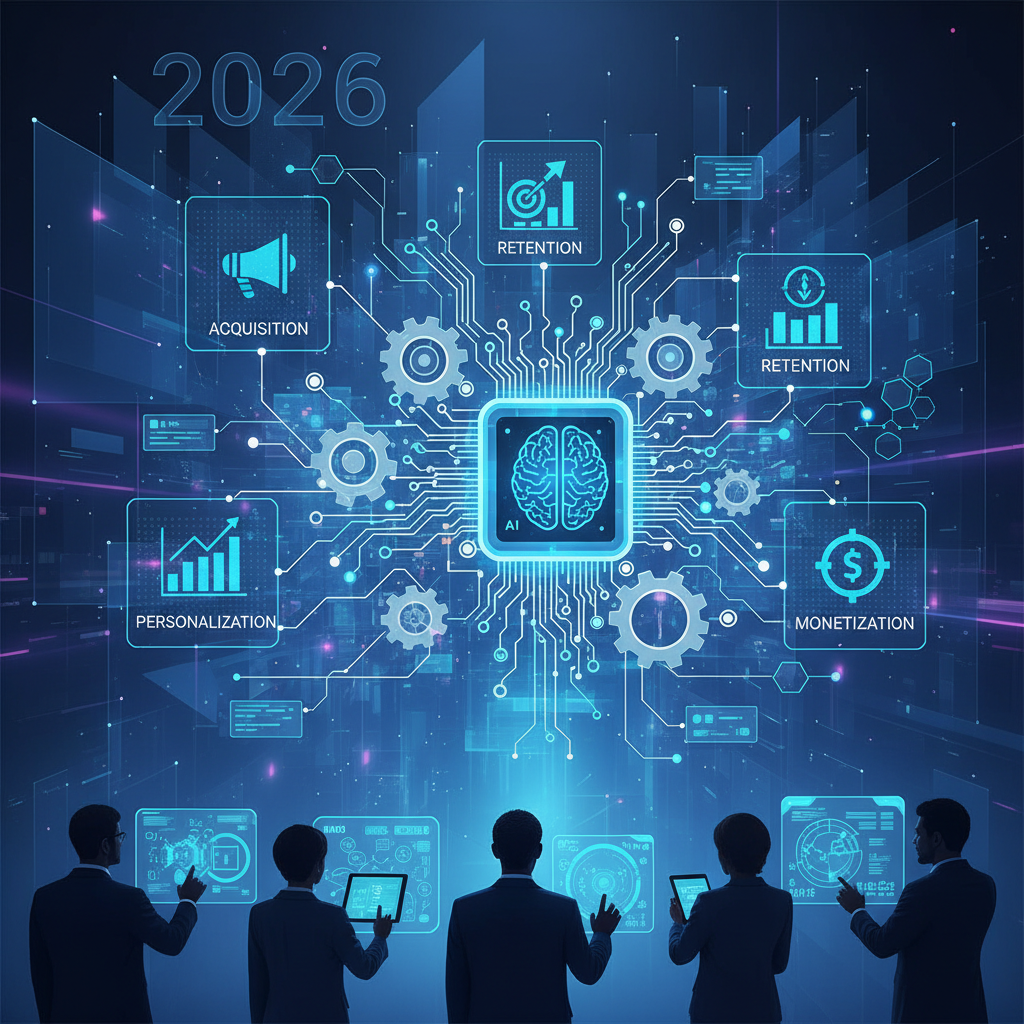
For the past few years, the hum of artificial intelligence in marketing has been a background melody of experimentation. CMOs and their teams have dabbled in AI, primarily through tactical applications like using ChatGPT for ad copy variations or drafting initial blog post outlines. This was the era of 'prompting'—treating AI as a clever, slightly unpredictable intern. But as we look toward 2026, that melody is becoming the full-throated orchestra of core business strategy. The pivot is on: we are moving from tactical AI usage to building an AI-first marketing engine as foundational infrastructure.
This shift requires a fundamental redefinition of the marketing stack. An 'AI-Native' stack is not a legacy CRM with a GPT plugin bolted on. It's an integrated ecosystem where data flows seamlessly into proprietary or fine-tuned models, generating predictive insights and automating personalized actions across the entire customer lifecycle. This is the difference between asking an AI to 'write me an email' and having an AI that autonomously decides who to email, what to say, and when to send it, based on a real-time understanding of that individual's behavior and intent.
The new mandate for the SaaS CMO is therefore a delicate balancing act. On one hand, there's pressure to capture immediate efficiency gains—the 'low-hanging fruit' like automating content briefs or social media updates. On the other, the real, long-term competitive advantage lies in building 'high-moat' AI implementations. These are systems deeply intertwined with your first-party data, creating a defensible platform that competitors cannot easily replicate. The true value isn't just in doing things faster; it's in doing things that were previously impossible.
Hyper-Personalization at Scale: Revolutionizing the SaaS Customer Journey
The promise of 1:1 marketing has been a North Star for decades, but it's largely been an illusion, achievable only for the highest-value accounts. AI is finally making hyper-personalization at scale a reality, transforming the anonymous user into a known, understood individual. The first casualty of this revolution is generic lead scoring.
Instead of relying on crude demographic and firmographic points systems, leading marketing teams are now using Large Language Models (LLMs) for predictive behavioral modeling. By analyzing subtle patterns in website interaction, content consumption, and in-app behavior, AI can predict future intent with startling accuracy. It's no longer about whether a lead opened an email, but about the context and timing of that engagement in their unique journey.
This capability powers the rise of autonomous demand generation. Imagine a world where every visitor to your website is greeted with a dynamically generated landing page, featuring copy, testimonials, and case studies that directly address their inferred pain points and industry. This level of personalization extends to ad copy, email nurture streams, and even the features highlighted in a product demo. Tools that offer a B2B website visitor tracking software component are foundational here, providing the raw behavioral data that fuels these sophisticated AI models. This allows you to identify anonymous companies on your site and understand their interests before they ever fill out a form.
The impact on Account-Based Marketing (ABM) is profound. Scaling ABM traditionally required a proportional increase in sales and marketing headcount. With AI, a small team can orchestrate highly personalized outreach to hundreds of target accounts simultaneously. AI can identify key stakeholders within a target company, analyze their public professional data to predict their priorities, and even generate personalized outreach collateral using tools like VisitReveal's Sales Collateral Generator, which creates bespoke follow-up pages in minutes. This rewrites the definition of a 'Sales-Ready Lead'. The new SRL is not just someone who fits an ICP and downloaded an ebook; it's a buying committee that has been AI-nurtured with relevant information and is showing clear, predictive signs of purchase intent.
Operational Transformation: Rewriting the Marketing Department’s Org Chart
The integration of AI isn't just a technological shift; it's an organizational one. The traditional marketing department structure is ill-suited for an AI-first world, and CMOs must now act as architects of a new kind of team. At the heart of this transformation is the Marketing Operations (MOps) function. Once a back-office support role, MOps is now the engine room for AI integration, responsible for data hygiene, system interoperability, and the deployment of AI workflows.
This raises a critical question for leadership: do you upskill your current team or hire new, AI-native talent? The answer, for most, will be a hybrid approach. It's crucial to invest in training your existing marketers—content creators, demand gen specialists, product marketers—to become 'AI-augmented'. They need to learn how to guide AI, interpret its outputs, and leverage it to enhance their strategic capabilities. Simultaneously, hiring for roles like 'AI Marketing Strategist' or 'Prompt Engineer' will become commonplace.
Generative AI also acts as a powerful solvent for the silos that have long plagued organizations. By processing and synthesizing unstructured data from across the company—sales call transcripts from the CRM, support tickets from Zendesk, product usage data from the data warehouse—AI can create a unified view of the customer. This bridges the chronic gap between Product, Sales, and Marketing. For this to work effectively, these teams need shared tools. An integrated Sales Enablement Software becomes the connective tissue, ensuring that the insights generated by marketing's AI are directly actionable by sales reps in their daily workflows, equipped with the right content and context for every interaction.
To govern this new way of working, smart CMOs are developing internal 'Golden Prompt' libraries. These are curated, tested, and refined prompts that produce reliable, on-brand results for specific tasks. Paired with standardized AI brand guidelines—which dictate tone, style, and ethical boundaries—these resources ensure consistency and quality as AI usage scales across the department.
Data Sovereignty and the New Trust Economy
As SaaS companies rush to embrace AI, a significant challenge emerges: data security and sovereignty. Using public LLMs like ChatGPT for sensitive tasks poses a real risk of data leakage and intellectual property loss. Any information you feed into a public model can potentially be used to train it, exposing your proprietary strategies, customer data, or internal communications.
This risk is driving a significant trend toward small, proprietary language models (SLMs). These are models trained exclusively on a company's own first-party data—its CRM records, website interactions, customer support conversations, and internal documentation. While less broadly capable than a model like GPT-4, an SLM offers two huge advantages: data security and contextual relevance. It understands your business, your customers, and your jargon in a way a public model never can, all while keeping your data securely in-house.
Another major concern is maintaining brand voice and preventing 'AI Hallucinations'—instances where the AI generates plausible but factually incorrect information. A strong human-in-the-loop process is non-negotiable. Every piece of AI-generated content destined for external communication must be reviewed, edited, and fact-checked by a human expert who understands the brand and the subject matter. This is not just about quality control; it's about trust. Customers need to trust that the information they receive from you is accurate and authentic.
Finally, the ethics of AI in marketing must be addressed head-on. Transparency is key. If you are using AI to automate outreach or personalize content, you must be clear about it. Customers are becoming increasingly savvy about AI-generated communication. Authenticity, even when AI-assisted, will become a key brand differentiator. The goal is to use AI to be more relevant and helpful, not to trick or deceive.
Reimagining the Content Lifecycle: Beyond the 'SEO Commodity' Trap
The internet is already being flooded with a tsunami of mediocre, AI-generated 'SEO content'. This creates both a challenge and an opportunity. The challenge is cutting through the noise. The opportunity is to use AI to create content with exceptionally high-signal and 'information gain'. Instead of asking AI to 'write a blog post about X,' the strategic approach is to use it as a research and analysis engine to uncover unique insights and data-driven perspectives that no one else is talking about.
One of the most powerful applications of AI in content is atomization. A single, high-effort content pillar—like a webinar, a research report, or a comprehensive guide from your SaaS Marketing Book of plays—can be fed to an AI and atomized into 50+ cross-channel assets. This includes social media threads, email newsletter blurbs, video scripts, infographics, and ad copy, all tailored to the specific platform and audience. This allows marketing teams to maximize the ROI of their cornerstone content pieces exponentially.
In this new era, the role of the human editor evolves into that of an 'AI Orchestrator'. Their job is not just to correct grammar, but to guide the AI, synthesize its findings, weave in human expertise and storytelling, and ensure the final product delivers genuine value. The 2500-word deep-dive isn't dead; it's just being co-created with a powerful new partner.
Furthermore, optimization strategies must evolve beyond traditional keywords to target Google's Search Generative Experience (SGE) and other AI-driven answer engines. This means creating content that is structured, authoritative, and directly answers user questions, making it easy for AI to cite and feature your brand as a trusted source.
The Tech Stack Audit: Rationalizing SaaS Spend in an AI World
The rise of AI necessitates a ruthless audit of the marketing tech stack. Many point solutions that perform a single function—like headline generation or basic analytics—are quickly becoming 'Redundant SaaS'. Their features are being absorbed into the native AI capabilities of core platforms like CRMs, CDPs, and marketing automation systems. Astute CMOs must regularly perform a comprehensive SaaS Growth & Marketing Audit to identify and eliminate these now-superfluous tools, freeing up budget for more strategic AI investments.
This leads to the classic 'Build vs. Buy' dilemma, now applied to AI. Should you buy an off-the-shelf AI tool, or build custom AI marketing middleware using APIs from providers like OpenAI or Anthropic? For most, a hybrid approach is best. Use established platforms for common tasks but consider building custom solutions for your 'high-moat' strategies that leverage your unique first-party data. Conducting a thorough SaaS Marketing Assessment can clarify where your biggest gaps and opportunities lie, guiding this critical decision.
As you rewire your stack, future-proofing the API layer is paramount. Your architecture must allow for seamless, real-time data flow between your CRM, Customer Data Platform (CDP), and the various LLM nodes you employ. Interoperability is the bedrock of an effective AI-first marketing engine.
Finally, your KPIs must evolve. In a world where AI can generate leads at near-zero marginal cost, 'Cost Per Lead' becomes a less meaningful metric. The focus must shift to 'Value Per Lead' and downstream metrics like conversion rates, pipeline velocity, and customer lifetime value. You might even find it useful to estimate potential ROI on leadership investments using a framework like a Fractional CMO Calculator to weigh the cost of strategic guidance against the potential uplift from a fully optimized, AI-driven engine.
Conclusion: The CMO as the Architect of the Autonomous Growth Engine
We are at a watershed moment in the history of marketing. The transition from project-based AI experiments to platform-wide intelligence is not a distant future; it is the immediate strategic imperative for every SaaS CMO. The goal is no longer just to manage campaigns, but to architect and oversee an autonomous growth engine—one that learns, adapts, and executes with increasing sophistication.
Getting there requires a phased roadmap. The next 12 months should focus on:
- Phases 1-3 (Months 1-3): Audit your stack, secure your data, and identify 2-3 high-impact, low-risk pilot projects. Begin upskilling your team.
- Phases 4-6 (Months 4-9): Scale successful pilots, develop your 'Golden Prompt' library, and begin integrating AI workflows with your core CRM and marketing automation platforms. Consider bringing in outside expertise, like a Fractional CMO for SaaS, to accelerate strategy development.
- Phases 7-9 (Months 10-12): Begin experimenting with proprietary models trained on first-party data and refine your AI-centric KPIs and reporting dashboards.
As McKinsey notes, generative AI is having a breakout year, and its impact is only beginning to be felt. In a saturated SaaS market, the competitive advantage will go not to the companies that simply use AI, but to those that rewire their entire growth model around it. The CMOs who act now as architects of this new engine will define the next generation of market leaders.