

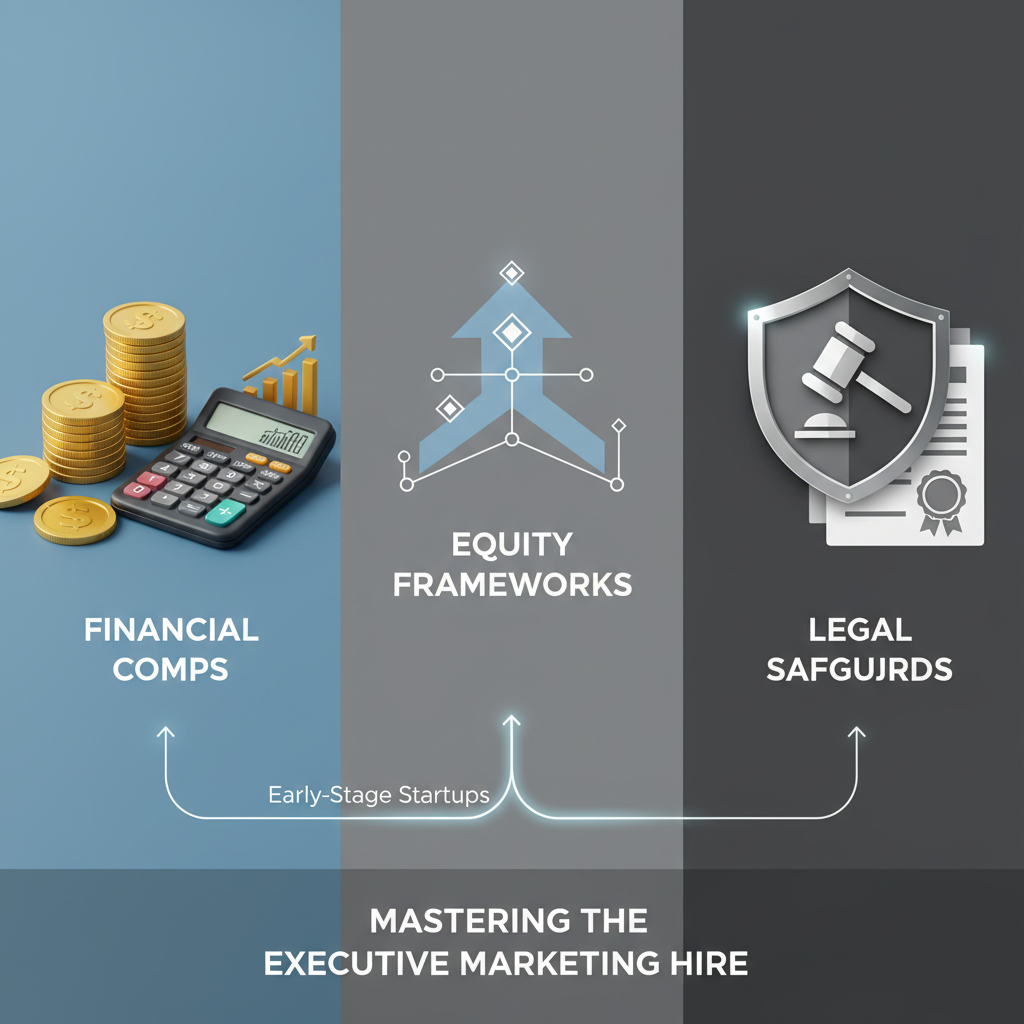
Hiring your first executive marketing leader is one of the most consequential decisions an early-stage founder will make. This isn't just about filling a seat; it's about onboarding a strategic partner who will shape your brand, build your growth engine, and command a significant portion of your budget and equity. Get it right, and you accelerate your path to product-market fit and revenue scale. Get it wrong, and you risk burning precious capital, diluting equity unnecessarily, and losing valuable time in a competitive market.
Too often, founders focus solely on a candidate's resume and past wins, overlooking the intricate financial and legal architecture that underpins a successful executive hire. The offer letter is more than just a salary; it's a complex agreement that must align incentives, protect the company, and attract top-tier talent. This comprehensive guide will walk you through the critical components of structuring a compelling and secure offer for your first VP of Marketing or CMO, from compensation benchmarks and equity allocation to essential legal clauses and negotiation tactics.
The Hierarchy of Early-Stage Marketing Leadership: VP vs. CMO Roles
Before you can craft an offer, you must define the role. The titles 'VP of Marketing' and 'Chief Marketing Officer (CMO)' are often used interchangeably, but for an early-stage startup, the distinction is crucial and has significant financial implications.
Analyzing the Strategic Distinction
A VP of Marketing is typically more hands-on and execution-oriented. Their primary focus is on building the foundational marketing machine: setting up demand generation channels, implementing marketing automation, managing a small team or agencies, and hitting MQL/SQL targets. They are the chief 'builder' of the growth engine.
A CMO, on the other hand, operates at a more strategic altitude. While still accountable for growth, their purview extends to brand architecture, category creation, market positioning, executive communications, and investor relations. They are a C-suite peer to the CTO and CPO, shaping the company's long-term trajectory. A Seed-stage company usually needs a VP; a Series A or B company is often ready for a true CMO.
Determining Salary Benchmarks and KPIs
Compensation directly reflects this strategic difference. The salary for a marketing executive is a function of the company's funding stage, location, and the role's scope.
- Seed Stage (VP Level): Cash is tight. Expect to offer a base salary that might be below the market rate for a large corporation, but compensated with a more substantial equity grant. The focus is on finding a builder who is betting on the company's upside.
- Series A (VP or CMO Level): With more capital, you can compete for more experienced talent. Base salaries become more competitive, and the equity component, while still significant, is a smaller percentage than a seed-stage grant.
Regardless of the title, this executive's pay must be justified by clear Key Performance Indicators (KPIs). These should be tied directly to business outcomes, not vanity metrics. Foundational KPIs include:
- Pipeline Contribution: The dollar value of the sales pipeline generated by marketing efforts.
- Customer Acquisition Cost (CAC): The total cost of marketing and sales to acquire a new customer.
- Lifetime Value (LTV) to CAC Ratio: A critical measure of the long-term profitability and sustainability of your growth model.
- Revenue Growth: Directly linking marketing efforts to Net New Annual Recurring Revenue (ARR).
To succeed, this leader will require the right infrastructure. Implementing a comprehensive Sales Enablement Platform from day one is essential for tracking these KPIs, aligning sales and marketing, and proving ROI on their strategic initiatives.
Equity Allocation: Typical Stakes for the First Marketing Hire
For most candidates, the primary financial motivation for joining an early-stage startup is equity. A cash salary pays the bills, but a meaningful equity stake creates a true owner who is deeply invested in the company's long-term success. Structuring this is part art, part science.
Baseline Equity Percentages
The standard equity range for a first non-founding marketing executive typically falls between 0.5% and 2.5% of the company's fully diluted shares. Where a candidate falls in this range depends on several factors:
- Stage: The earlier the hire, the higher the risk and the larger the equity grant. A 'founding' VP of Marketing joining a pre-seed company might command 2% or more. A VP joining a 50-person Series A company is more likely in the 0.5% to 1.25% range.
- Experience and Network: A candidate with a proven track record, such as leading marketing at a company that had a successful exit, can command a premium. Their network of talent, press, and investors is a valuable asset you are acquiring.
- Cash vs. Equity Trade-off: If a candidate is willing to take a significantly lower cash salary, they have a strong case for a higher equity percentage. This demonstrates their belief in the company's potential and aligns them perfectly with the founders.
It's also important to be transparent about what this percentage means. Discussing the number of options and the company's current valuation gives the candidate a clearer picture of the potential financial outcome.
Vesting Schedules and the 'Cliff' for Marketing Leaders
Equity isn't handed over on day one. It's earned over time through a vesting schedule, which protects the company from a key employee leaving shortly after joining with a large chunk of ownership.
The Standard Vesting Schedule
The almost universal standard is a 4-year vesting schedule with a 1-year cliff. Here’s how it works:
- The Cliff: The employee must stay with the company for at least one year to receive any equity. If they leave or are terminated before the 12-month mark, they get nothing.
- Post-Cliff Vesting: On their one-year anniversary, 25% of their total equity grant vests. The remaining 75% then vests in monthly or quarterly increments over the next three years.
This structure ensures a mutual commitment. The company gets a full year to evaluate the executive's performance, and the executive is incentivized to stay and build long-term value.
Acceleration Clauses
A critical negotiation point for any executive is an acceleration clause, which dictates what happens to unvested equity in the event of an acquisition. The most common form is 'Double-Trigger' Acceleration. This requires two events to occur for vesting to accelerate:
- First Trigger: The company undergoes a change of control (e.g., is acquired).
- Second Trigger: The executive is terminated without cause or resigns for 'good reason' (e.g., a significant reduction in role or pay) within a certain period (usually 12 months) following the acquisition.
This is fair to both sides. It prevents an executive from quitting and cashing out immediately after a sale, but it protects them from being fired by the acquiring company just to avoid paying out their remaining equity.
Incentive-Based Pay: Structuring Bonuses and Performance Milestones
In addition to base salary and equity, a performance bonus is a powerful tool to drive short-term results and reward over-performance. A poorly structured bonus, however, can incentivize the wrong behaviors.
Connecting Bonuses to Revenue Growth
The most effective bonus plans for marketing leaders are tied to metrics that directly impact the bottom line. While MQLs are a part of the story, the bonus structure should be heavily weighted toward revenue-centric goals like ARR and qualified sales pipeline.
A common variable compensation model is an 80/20 or 70/30 split, where 80% of the target compensation is the base salary and 20% is a variable bonus. This bonus should be non-discretionary and based on a clear, mutually agreed-upon formula. For example, the bonus could be tiered based on achieving 80%, 100%, and 120% of the new ARR marketing-sourced goal.
The Legal Pitfalls of Poorly Structured Incentives
One of the biggest mistakes is tying compensation solely to lead volume. This inevitably leads to a focus on quantity over quality, flooding the sales team with unqualified leads and creating friction between departments. To avoid this, bonus metrics should focus on later-stage funnel conversions, such as Sales Accepted Leads (SALs) or Opportunities created. You need tools that give insight into lead quality; for example, using B2B website visitor tracking software can help your marketing leader identify which leads come from high-fit, enterprise-level companies, allowing for better scoring and prioritization.
Drafting the Air-Tight Offer Letter: Essential Legal Clauses
The offer letter is a legally binding document. It must be drafted with care, ideally with the help of legal counsel, to protect both the company and the new hire.
- Duties and Reporting Structure: Clearly define the role, responsibilities, title, and who the executive will report to (typically the CEO). If they will have Board Observer status, this should be stated.
- Proprietary Information and Inventions Assignment (PIIA): This is a non-negotiable clause. It stipulates that all intellectual property, work product, and inventions created by the employee related to the company's business belong to the company.
- Non-Compete and Non-Solicitation: A non-solicitation clause prevents the departing employee from poaching your team members or customers for a set period. A non-compete, which prevents them from working for a competitor, is much harder to enforce and is illegal in some states like California. Consult a lawyer to understand what is enforceable in your jurisdiction.
- Severance: For an executive-level hire, a severance package (often called a 'golden parachute') is standard. A typical arrangement might be 3-6 months of base salary and benefits if they are terminated without cause. This gives the candidate the security to take a risk on your startup.
Negotiation Strategies for Founders and Candidates
Negotiation shouldn't be adversarial. It's the first collaboration between a founder and their new marketing leader. The goal is to reach a 'Total Rewards' package that feels like a win-win.
Evaluating the 'Total Rewards' Package
Smart candidates look beyond the base salary. Founders should frame the offer around the entire package:
- Cash Compensation: Base salary + target bonus.
- Equity Value: The potential upside of their stock options.
- Benefits: Health insurance, 401(k), and other perks.
- Flexibility and Autonomy: The ability to build their own team and strategy.
When there's a gap in expectations, consider creative solutions like a sign-on bonus to make up for a lower base salary in the first year or for forfeited bonuses from their previous job. To ground the discussion in reality, both parties should use market data. Founders can gain insight into the value a top-tier marketer creates by exploring resources like a Fractional CMO Calculator to benchmark costs against expected outcomes. Meanwhile, candidates can reference industry compensation surveys. For deeper strategic understanding, both sides might benefit from materials like a comprehensive SaaS Marketing Book that outlines modern growth frameworks.
Post-Hire Financial Governance and Compliance
The financial and legal obligations don't end once the offer letter is signed. Proper governance is key to protecting the company and ensuring your equity is compliant.
Section 409A Valuations
To grant stock options legally, your startup must have a recent Section 409A valuation performed by an independent third party. This valuation determines the Fair Market Value (FMV) of your common stock, which sets the 'strike price'—the price at which an employee can purchase shares. This valuation must be updated at least every 12 months or after any material event (like a new funding round). Failure to comply can result in severe tax penalties for the employee.
Understanding Stock Options (ISOs vs. NSOs)
You'll likely be granting either Incentive Stock Options (ISOs) or Non-qualified Stock Options (NSOs). ISOs offer potential tax advantages to the employee but come with stricter rules. NSOs are more flexible for the company but are taxed as ordinary income for the employee upon exercise. Your legal and tax advisors can help you decide which is appropriate.
Insurance and Stipends
Once you have an executive team, you must secure Directors and Officers (D&O) insurance. This protects your leaders from personal liability in the event of a lawsuit against the company. Furthermore, in today's remote-first world, be sure to structure home-office and other stipends in a way that is compliant with tax and employment laws across different states.
Conclusion: Building a Foundation for Growth
Hiring your first marketing leader is a landmark event. While finding someone with the right skills and cultural fit is essential, the financial and legal structure of the deal is what creates a sustainable, aligned partnership. By carefully considering the role, benchmarking compensation, being thoughtful about equity, and ensuring all legal safeguards are in place, you are not just hiring an employee—you are recruiting a co-owner in your company's future success.
Before you even start the search, it can be incredibly valuable to get an objective view of your current state. A SaaS Growth & Marketing Audit can pinpoint your exact needs and define the priorities for your new hire. For some startups, jumping to a full-time executive might be premature; exploring a Fractional CMO for SaaS can provide strategic leadership without the full financial commitment. Ultimately, a clear understanding of your own marketing maturity, best gained through a structured SaaS Marketing Assessment, will ensure you hire the right leader, with the right incentives, at the right time.