

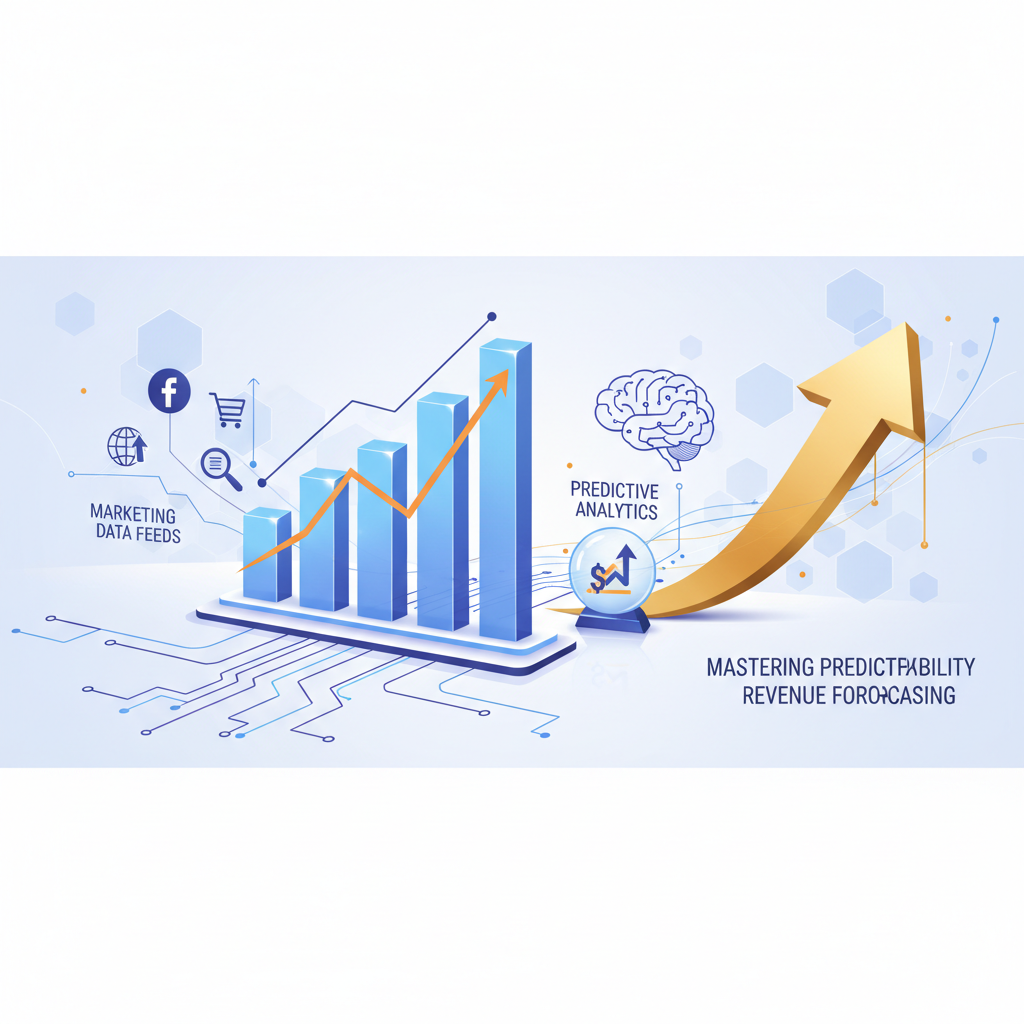
In the high-stakes world of B2B business, predictability isn't just a convenience; it's a strategic imperative. The ability to accurately forecast revenue empowers leaders to make confident decisions about hiring, investment, and market expansion. Yet, for many organizations, forecasting remains a frustrating exercise in guesswork, often based on outdated historical averages and optimistic sales rep commitments. The result is a wide confidence interval and a constant state of uncertainty.
What if you could transform your revenue projections from a rearview mirror glance into a high-definition forward-looking roadmap? This is the promise of predictive analytics, powered by real-time marketing data feeds. By moving beyond traditional methods and embracing a data-driven approach, companies can build sophisticated models that not only predict what revenue will be but also explain why.
The Evolution of Financial Projections: Can Predictive Analytics Improve Sales Accuracy?
The leap from traditional forecasting to predictive analytics represents a fundamental shift in business intelligence. It's about evolving from static snapshots to dynamic, living models that adapt to new information. This evolution is critical for any company looking to gain a competitive edge.
- From Historical Averages to Predictive Modeling: Traditional forecasting often relies on simple extrapolation: 'We grew 20% last quarter, so we'll project 20% growth for the next.' This method ignores market shifts, campaign performance, and buying behavior changes. Predictive modeling, in contrast, ingests multiple variables—such as web traffic, lead quality, engagement scores, and sales cycle velocity—to build a forward-looking algorithm that anticipates outcomes rather than just reflecting the past.
- The Impact of Real-Time Data: The accuracy of a forecast is directly tied to the freshness and granularity of its data inputs. Real-time marketing data, such as a surge in website visitors from a target account or a high-value lead interacting with pricing pages, provides powerful leading indicators. By integrating tools like a B2B website visitor tracking software, you can capture these intent signals as they happen. For example, VisitReveal's Lead Re-Visit Notification alerts a sales rep the moment a prospect in their CRM returns to the site, offering a real-time signal that can dramatically improve forecast accuracy for that specific deal.
- Limitations of Spreadsheet-Based Forecasting: Spreadsheets are prone to human error, version control issues, and a lack of scalability. They cannot easily process the volume or velocity of data required for modern predictive analytics. A centralized sales enablement platform with an integrated CRM and reporting capabilities, like the B2B Sales CRM and Sales Reports offered by VisitReveal, eliminates these silos and creates a single source of truth.
- Quantifying the ROI: High-fidelity forecasting delivers tangible returns. It leads to more efficient resource allocation, optimized marketing spend, reduced cash flow volatility, and increased investor confidence. By accurately predicting pipeline, businesses can avoid over-hiring or under-investing, ensuring capital is deployed for maximum impact. A preliminary step to understanding your potential is often a comprehensive SaaS growth & marketing audit to identify data gaps and opportunities.
Architecting the Lead-to-Revenue Forecasting Model
A robust forecasting model is not a black box; it's a carefully architected system that maps the entire customer journey. Building this architecture requires a deep understanding of your funnel dynamics and the data that defines them.
Mapping the Full-Funnel Journey
The model must connect the earliest marketing touchpoints to the final closed-won deal. This involves tracking a lead's progression from an anonymous website visitor to a Marketing Qualified Lead (MQL), a Sales Qualified Lead (SQL), an opportunity, and finally, to Annual Recurring Revenue (ARR). Each stage must have clear, quantifiable entry and exit criteria.
Incorporating Velocity Metrics
Revenue isn't just about the what, but also the when. Velocity metrics calculate the time it takes for a deal to move from one stage to the next. By analyzing historical data, you can determine the average time-in-stage and use this to predict when a current opportunity is likely to close. This helps differentiate a deal that might close this quarter from one that will slip into the next, a critical distinction for accurate projections.
Weighted Pipeline vs. Stage-Probability Modeling
A simple weighted pipeline applies a generic percentage to the value of all deals in a given stage (e.g., 50% for deals in the 'Proposal' stage). Stage-probability modeling is more sophisticated. It calculates the historical conversion rate from each stage to 'Closed-Won'. This provides a more accurate, data-backed probability for each opportunity, which can then be refined further by layering on engagement data and other leading indicators.
Integration Strategy: How to Use Marketing Data for Sales Projections
The power of predictive forecasting lies in its ability to synthesize data from across the business. A fragmented tech stack is the biggest barrier to success. An effective integration strategy is non-negotiable.
- Normalizing Disparate Data Sources: Your CRM, marketing automation platform, and any Customer Data Platform (CDP) must speak the same language. This means standardizing field names, data formats, and definitions (e.g., what constitutes an MQL). An all-in-one platform like VisitReveal, which combines a B2B Sales CRM with B2B Lead Generation Tools and tracking, inherently solves many of these normalization challenges.
- Leveraging Intent Data and Engagement Scores: Don't just track activities; score them. A lead who downloaded a whitepaper is different from one who attended a demo and visited the pricing page three times. These engagement scores, often tracked in marketing automation systems, are powerful leading indicators of intent and can be used to adjust the probability of a deal closing.
- Accounting for Seasonality: Most B2B businesses experience cyclicality. Budgets may freeze at the end of the year or open up at the beginning of a quarter. Your model must be sophisticated enough to account for these seasonal trends, adjusting forecasts based on historical performance during similar periods. Ignoring seasonality can lead to significant forecast misses.
- Automating Data Ingestion: Manual data entry is the enemy of accuracy. Every time a sales rep manually updates a deal stage or logs a call, there's a risk of bias, delay, or error. Automating data ingestion—through email integration, calendar tracking, and automated activity logging—ensures the data feeding your model is objective and up-to-the-minute.
The Role of Marketing Source Attribution in Revenue Forecasting
To predict future revenue, you must understand where your current revenue comes from. Marketing attribution is the key to connecting marketing spend to sales outcomes, and it's a critical input for any forecasting model.
Moving Beyond Last-Click
Last-click attribution, which gives 100% of the credit to the final touchpoint before conversion, is dangerously simplistic. A B2B buyer's journey is long and complex, involving multiple touchpoints across various channels. A multi-touch attribution (MTA) model (e.g., linear, U-shaped, or data-driven) provides a more holistic view, distributing credit across the entire path to purchase. This allows you to understand the true influence of top-of-funnel activities like blog posts and social media.
Determining Incremental Revenue Lift
With a proper attribution model, you can answer critical questions: 'If we increase our LinkedIn ad spend by 15%, what is the expected impact on pipeline and revenue in 90 days?' By analyzing the historical performance of each channel, you can determine its incremental revenue lift and use this to model the outcome of future marketing investments. This transforms the marketing budget from a cost center into a predictable revenue driver. Performing an initial SaaS Marketing Assessment can help benchmark your current channel performance.
Stochastic Sales Forecasting for B2B: Managing Uncertainty
Even the best models operate in an uncertain world. Rather than producing a single, definitive revenue number—a practice that creates a brittle forecast—advanced techniques embrace uncertainty and model it directly.
- Monte Carlo Simulations: Instead of using fixed inputs (e.g., 'our conversion rate is 5%'), a Monte Carlo simulation runs a model thousands of times, each time using slightly different inputs drawn from a probability distribution. For example, it might model scenarios where the conversion rate is 4.5%, 5.2%, or 4.8%. The result is not one number, but a range of possible outcomes and the probability of achieving each one.
- From a Single Number to a Risk-Adjusted Spectrum: This approach allows leaders to say, 'There is a 90% probability we will hit at least $4.8M in revenue, a 60% probability of hitting $5.1M, and a 10% probability of exceeding $5.5M.' This risk-adjusted spectrum is infinitely more valuable for strategic planning than a single, fragile point estimate.
- Scenario Planning: Advanced models can also be used for 'what-if' analysis. What happens to our forecast if a major competitor launches a new product? What if our top-performing marketing channel becomes 20% more expensive? By modeling these scenarios, businesses can develop contingency plans and become more resilient to market volatility. For complex strategic planning, organizations often bring in outside expertise, such as a Fractional CMO for SaaS, to guide the process.
Predictive Modeling for High-Growth SaaS Revenue
The SaaS business model, with its recurring revenue streams, presents unique challenges and opportunities for forecasting. A generic model won't suffice; it must be tailored to the specifics of SaaS unit economics.
- Cohorted Revenue Analysis: Instead of looking at all customers as a monolith, cohort analysis groups customers by their acquisition date (e.g., the 'January 2024 cohort'). Forecasting can then be done on a cohort-by-cohort basis, providing a much clearer picture of retention, expansion, and LTV trends over time.
- The NDR Factor: Net Dollar Retention (NDR) is a critical SaaS metric that measures revenue growth from your existing customer base (upsells, cross-sells) minus churn and downgrades. A strong NDR can be a massive revenue driver. Predictive models must include a component for forecasting expansion revenue, which is often more predictable and profitable than new business revenue.
- Churn Prediction Integration: Just as you forecast revenue gains, you must also forecast revenue losses. By analyzing product usage data, support ticket frequency, and customer sentiment signals, machine learning models can predict which accounts are at high risk of churning. This anticipated loss can be subtracted from the gross revenue forecast for a more realistic net revenue prediction.
Understanding these complex financial dynamics is key. Tools like a Fractional CMO Calculator can help model the financial impact of strategic marketing leadership on these core SaaS metrics.
Strategic Frameworks: Top-Down vs. Bottom-Up Marketing Forecasting
There are two primary philosophical approaches to forecasting. The most robust strategy involves reconciling them.
- Top-Down Forecasting: This method starts with a high-level goal, often set by executives or investors (e.g., 'We need to achieve $10M ARR this year'). The revenue goal is then divided among regions, teams, and reps. While useful for setting ambitious targets, this approach can be disconnected from on-the-ground reality if not balanced with operational data.
- Bottom-Up Forecasting: This approach starts with the available inputs and historical data. It asks: 'Given our current lead volume, conversion rates, and sales cycle length, what revenue can we realistically generate?' This model is grounded in operational capacity. VisitReveal's Sales Goals feature embodies this, allowing you to set a goal and then reverse-engineer the daily activities needed to achieve it.
- Implementing a Hybrid Approach: The gold standard is a hybrid model that reconciles the top-down ambition with the bottom-up reality. This creates a healthy tension: the bottom-up forecast shows what's likely based on current performance, while the top-down goal highlights the performance gaps that need to be closed through new strategies, improved efficiency, or increased investment.
The Future of Revenue Intelligence: AI and Continuous Feedback Loops
The field of revenue forecasting is evolving rapidly, driven by advancements in artificial intelligence and machine learning. The future is not just predictive, but adaptive.
Machine Learning (ML) Refinement
The most advanced models learn and improve over time. By comparing forecasted revenue to actual results (forecast-to-actual deviations), the ML algorithm identifies where its assumptions were wrong and adjusts its own weighting and logic for the next cycle. This creates a continuous feedback loop, making the model progressively more accurate with each quarter.
The Shift Toward Autonomous Forecasting
As models become more sophisticated and data integration becomes seamless, we are moving toward a state of autonomous forecasting. Real-time dashboards will continuously update revenue projections as new data—a new lead, a deal moving stages, a change in web traffic—flows into the system. This provides leaders with a live, dynamic view of business health, moving beyond static quarterly reports.
Balancing Algorithms with Human Intuition
Despite the power of AI, human expertise remains invaluable. A sales director might know that a certain deal, despite looking weak on paper, is being driven by a strong internal champion. This qualitative insight, or 'human-in-the-loop' input, can be used to override or adjust the algorithmic output. The optimal system is one that blends algorithmic precision with seasoned human judgment.
Mastering this blend of art and science is an ongoing journey. For those looking to deepen their strategic knowledge, resources like a comprehensive SaaS marketing book can provide the foundational principles needed to lead a modern, data-driven revenue organization.