

SaaS Marketing
Blog
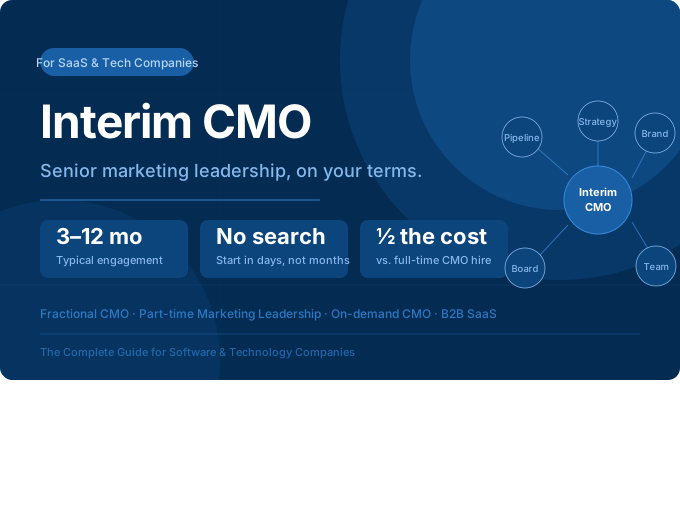
Interim CMO for SaaS and Tech Companies: The Complete Guide to Flexible Marketing Leadership
When a B2B SaaS company loses its head of marketing, stalls out between funding rounds, or simply can't justify a $300K+ full-time hire, the pressure to keep pipeline moving doesn't pause. Revenue targets don't move. Board expectations don't lower. Deals still need to close.
This is exactly where an interim CMO — also called a fractional CMO or part-time marketing leader — has become one of the most strategically valuable roles in the modern software company. What was once a stopgap measure has evolved into a deliberate, often preferred model for technology companies at every stage of growth.
This guide covers everything software, SaaS, and tech founders and operators need to know about hiring and working with an interim CMO: what the role actually entails, when it makes sense, what to look for, and how to set it up for success.
What Is an Interim CMO?
An interim CMO is an experienced marketing executive who steps into a Chief Marketing Officer role on a temporary, contract, or part-time basis. Unlike a full-time CMO hire, an interim CMO typically engages for a defined period — anywhere from three months to two years — with a specific mandate: stabilize, build, or scale the marketing function until a permanent leader is in place or until the company's needs change.
In the SaaS world, "interim CMO" is often used interchangeably with related terms:
Fractional CMO: A senior marketing leader who works across multiple clients simultaneously, dedicating a fraction of their time (typically 10–20 hours per week) to each. Most fractional CMOs bring deep B2B SaaS experience and operate across two to four companies at once.
Part-time CMO: Similar to fractional, though "part-time" sometimes implies a single-client engagement at reduced hours rather than the multi-client fractional model.
On-demand CMO: A newer term that emphasizes flexibility — the ability to ramp up or ramp down engagement based on the company's growth stage or immediate needs.
While the terminology differs slightly, the underlying value proposition is the same: executive-level marketing leadership without the full-time overhead, equity dilution, or lengthy recruitment cycle.
Why SaaS and Tech Companies Are Turning to Interim Marketing Leadership
The software industry has a structural mismatch problem. The demand for experienced B2B marketing leaders — people who have actually scaled a SaaS company from $1M to $10M ARR, or run a product-led growth motion, or built a demand gen engine from scratch — vastly outpaces supply. Full-time CMOs at that experience level command total compensation packages well above $250,000, and the best ones are rarely looking.
Meanwhile, the window during which a software company needs that level of marketing leadership but can't sustain the cost is often the longest stretch of its existence: seed through Series B, roughly $500K to $20M ARR.
Enter the interim CMO model.
The Funding Gap Problem
Most early-stage SaaS companies raise capital in tranches. Between rounds — or in the six to twelve months after a raise when the team is still being assembled — there's a gap where marketing needs to perform at a high level without the resources to hire for every seat. Part-time marketing leadership fills this gap precisely. An experienced fractional CMO can build the strategy, manage agency relationships, mentor junior team members, and report to the board, all while the company works toward a full-time hire.
The Transition Problem
One of the most common triggers for bringing in an interim CMO is executive departure. When a VP of Marketing or CMO leaves a software company — whether voluntarily, as part of a restructuring, or due to misalignment with the company's next stage — the average search for a full-time replacement takes four to six months. That's four to six months of leadership vacuum in the function most directly responsible for pipeline. An interim CMO bridges that gap without missing a quarter.
The "First CMO" Problem
Many SaaS founders are technical or product-oriented. When the company hits a stage where it needs to build a real marketing function — typically somewhere around $3M to $10M ARR — there's no internal leader to own that work. Hiring a full-time CMO as the company's first dedicated marketing executive is a high-risk move: if the hire is wrong, the cost of a bad decision (in time, equity, and organizational momentum) is enormous. Bringing in an interim or fractional CMO first allows the company to define what the role actually needs to look like before making a permanent commitment.
What an Interim CMO Actually Does in a SaaS Company
The scope of an interim CMO engagement varies, but in the B2B SaaS context there are several recurring patterns in what these engagements actually involve.
Marketing Audit and Strategy Development
Most interim CMO engagements begin with a diagnostic. The fractional CMO assesses the existing marketing function: What channels are generating pipeline? What's the cost per opportunity? How does the company position against competitors? Is the ICP clearly defined and is messaging aligned to it? Is there a content strategy, and is it working?
This audit typically surfaces the two or three highest-leverage opportunities and the one or two things the company should stop doing. It's often the first time the leadership team has had a clear-eyed external view of the marketing operation.
Demand Generation and Pipeline Ownership
For most B2B SaaS companies, marketing's primary job is generating qualified pipeline. An interim CMO takes direct ownership of this — not just setting strategy but managing execution, whether through internal team members, agencies, or contractors. This includes paid acquisition, SEO, content marketing, email nurture, webinars, and outbound-assist campaigns.
A critical distinction: a good interim CMO brings their own frameworks and playbooks but adapts them to the company's specific motion. A product-led growth SaaS company needs a very different demand gen approach than an enterprise sales-led SaaS company, and the best interim marketing leaders are explicit about which motions they've run successfully.
Brand Positioning and Messaging
In software, positioning is strategy. An interim CMO will typically own or co-own the process of sharpening how the company describes what it does, who it's for, and why it's different. This work underpins everything downstream — website copy, sales decks, email sequences, paid ads, and analyst relations. Companies that have grown through referrals and word of mouth often come to this work for the first time when they hire their first interim marketing leader.
Team Building and Vendor Management
Many interim CMOs are brought in specifically to build the marketing function. This means defining the org structure, writing job descriptions, managing the hiring process for in-house roles, selecting and managing agencies or freelancers, and establishing the tools and reporting infrastructure the team will use. This is particularly common in Series A and early Series B SaaS companies that have a small marketing team — perhaps one or two generalists — and need to grow it deliberately.
Board-Level Reporting and Investor Relations
A fractional CMO operating at the VP or C-suite level is expected to communicate marketing performance to the board and investors. This means building the reporting frameworks (pipeline attribution, CAC by channel, LTV:CAC, MQL-to-SQL conversion rates) and presenting results with appropriate context. For software companies that have investors with high marketing expectations, having an experienced CMO in the room — even on a fractional basis — materially changes the quality of those conversations.
The Interim CMO vs. Fractional CMO Distinction (and When It Matters)
In practice, most people use "interim CMO" and "fractional CMO" interchangeably, but there's a meaningful difference worth understanding.
An interim CMO typically refers to a full-time or near-full-time engagement with a single company, usually for a defined period. The classic use case is a company whose CMO has left and needs immediate, dedicated coverage while they search for a permanent replacement. The interim CMO may be brought in through a retained search firm or through a direct referral, and their primary commitment is to that one company.
A fractional CMO, by contrast, works with multiple clients simultaneously. This model suits companies that need senior marketing leadership but not at a full-time level — a Series A SaaS company at $4M ARR likely doesn't have enough marketing work to occupy a seasoned CMO full-time. A fractional CMO working 15 hours per week brings the strategic firepower of a seasoned executive at a fraction of the cost.
For SaaS companies, the fractional model has become particularly popular because it maps naturally to the cadence of early-stage marketing work: strategic planning sprints, campaign launches, board prep, hiring cycles. These don't require 40-hour-a-week presence; they require high-quality thinking and experienced decision-making delivered at the right moments.
When a SaaS Company Should (and Shouldn't) Hire an Interim CMO
Understanding when this model is the right fit — and when it isn't — can save a software company significant time and money.
Strong Use Cases for Interim Marketing Leadership
Post-funding growth acceleration. A SaaS company that has just raised a Series A and needs to prove out go-to-market before Series B is often a perfect fit for a fractional CMO. The company needs experienced leadership to build and run the marketing engine, but isn't yet at the scale to justify a full-time executive.
CMO departure and replacement. When the marketing leader leaves and the company needs to maintain momentum while searching for a permanent hire, an interim CMO provides continuity. The best interim CMOs in this situation also help the company define what they actually need in the permanent hire.
Pre-sale or acquisition preparation. Software companies preparing for M&A sometimes bring in an interim CMO to professionalize the marketing function, clean up positioning, and improve the optics of the go-to-market story for prospective acquirers.
Category creation or repositioning. When a SaaS company is pivoting its ICP, launching a new product line, or trying to establish category leadership, that's high-stakes positioning work that benefits from experienced guidance. A fractional CMO who has done this before brings a playbook that can be adapted and executed quickly.
Marketing-sales misalignment. Many SaaS companies struggle with tension between marketing and sales — marketing says they're generating leads, sales says the leads aren't quality. A neutral, experienced interim CMO can diagnose the real problem (attribution? ICP definition? handoff processes?) and fix it faster than an internal hire could.
When the Model Doesn't Work Well
Interim and fractional marketing leadership is not the right fit for every situation. Companies that need deep operational immersion — day-to-day management of a large team, continuous presence in internal Slack channels, and real-time decision-making — may find that a fractional CMO's limited hours create bottlenecks.
The model also doesn't work when the company hasn't committed to giving the interim leader real authority. Fractional CMOs are not well-positioned to operate as consultants who deliver recommendations and then watch them be ignored. The engagements that generate the most value are ones where the interim CMO has clear ownership of marketing outcomes, a direct line to the CEO, and permission to make and implement decisions.
What to Look for in an Interim CMO for a Software Company
Not all fractional CMOs are created equal, and the SaaS market specifically has unique characteristics that make relevant experience critically important. Here's what to look for.
B2B SaaS-Specific Experience
The marketing playbook for a consumer app is completely different from the playbook for a $5,000/year B2B SaaS product. Insist on candidates who have built and run B2B SaaS marketing specifically — ideally at companies with similar ACV, sales motion (PLG vs. sales-led), and target market (SMB vs. mid-market vs. enterprise).
Stage Relevance
An executive who scaled a 200-person marketing org at a public software company may not be the right person to build a marketing function from scratch at a 30-person Series A company. Look for interim CMOs whose experience maps to your current stage, not just your target stage.
Pipeline Ownership Mentality
In B2B SaaS, the best CMOs are obsessed with pipeline and revenue, not just brand and awareness. Ask candidates how they've measured marketing's contribution to revenue, how they've thought about CAC and LTV, and how they've navigated the tension between short-term pipeline generation and long-term brand building. The answers reveal a lot about whether they'll operate as a strategic partner to the revenue organization or as a separate brand-focused function.
Operator vs. Advisor Orientation
Some fractional CMOs are fundamentally advisors: they provide guidance, frameworks, and recommendations but expect others to execute. Others are operators: they will roll up their sleeves, write the brief, brief the designer, and review the campaign before it goes live. Most early-stage SaaS companies need an operator, not just an advisor.
Transparent Availability and Capacity
A fractional CMO who is spread across six clients simultaneously may not be able to give your company the responsiveness it needs. Ask directly: How many clients are you currently working with? What's your typical weekly availability? What does your engagement structure look like week-to-week? The answers should give you confidence that you'll have real access to the person you're hiring.
How to Structure an Interim CMO Engagement
Getting the structure right is as important as choosing the right person. Here's how high-performing SaaS companies set these engagements up.
Define the Mandate Clearly
Before the first day, align with the interim CMO on exactly what success looks like. Is the primary goal pipeline generation? Repositioning? Building the team? Preparing for a board presentation? The more specific the mandate, the more likely the engagement is to deliver measurable value. Vague engagements produce vague results.
Establish Reporting Lines and Decision Rights
The interim CMO should report directly to the CEO or COO, and should have clear authority over marketing budget, vendor relationships, and team direction. Without this authority, the engagement becomes advisory by default.
Set a Cadence
Most fractional CMO engagements work well with a weekly or bi-weekly rhythm: a standing sync with the CEO, a team standup or async update, and a monthly board-ready metrics review. The cadence creates accountability and ensures the interim leader is getting the information they need to make good decisions.
Budget for Execution
One of the most common ways these engagements under-deliver is when the interim CMO has great strategic clarity but no budget or resources to execute. Be clear upfront about what budget the interim CMO will manage, what team they'll have access to, and what agency or contractor relationships are available. A fractional CMO without execution resources is an expensive consultant.
Plan for Transition
Whether the goal is to eventually hire a full-time CMO or to continue with the fractional model indefinitely, plan for the transition from day one. The interim CMO should be building documentation, processes, and team capability in a way that doesn't create dependency on them. The best engagements leave the company stronger than they found it — regardless of whether the same leader continues.
The Economics of Interim and Fractional CMO Engagements
Understanding the cost structure helps software companies evaluate whether this model makes financial sense for their stage.
A full-time CMO at a Series B SaaS company typically commands $250,000 to $400,000 in base salary, plus equity (typically 0.3% to 0.8% at early stages), plus benefits and employer taxes. Total first-year cost is often $350,000 to $500,000, and that's before accounting for the six-to-twelve-month cost of a wrong hire.
A fractional CMO typically charges $150 to $400 per hour, or retainer-based pricing in the range of $8,000 to $25,000 per month for a meaningful part-time engagement. An interim CMO in a near-full-time capacity (thirty to forty hours per week) may charge $15,000 to $35,000 per month on a contract basis.
The economic case is clearest for companies that need executive-level marketing leadership but aren't yet generating enough revenue to support the full-time overhead. For a $3M ARR SaaS company, paying $12,000 per month for a 15-hours-per-week fractional CMO is a materially better bet than paying $300,000 for a full-time hire they may not be able to utilize fully — or worse, a full-time hire who turns out to be wrong for the role.
Common Mistakes SaaS Companies Make with Interim CMO Hires
Even well-run software companies make predictable mistakes when bringing in part-time marketing leadership for the first time.
Treating the engagement as a consulting project. Interim and fractional CMOs add the most value when they have real ownership, not just advisory input. If the executive team isn't willing to let the interim CMO make decisions, they're better served by a strategy consultant at a lower price point.
Hiring for pedigree over fit. A CMO who spent ten years in enterprise software is not necessarily the right person for a PLG-focused developer tools company. Relevant experience matters more than impressive logos.
Underinvesting in onboarding. Even experienced executives need context. A fractional CMO who gets two hours of onboarding will spend weeks learning things they could have learned in a day. Invest in a thorough handoff of customer data, competitive research, historical marketing performance, and team context.
Expecting miracles in month one. Marketing compounding takes time. An interim CMO who is building properly — tightening positioning, fixing the ICP, restructuring demand gen infrastructure — may show limited top-of-funnel results in the first sixty days. The question is whether the work being done is the right work, not whether pipeline has already doubled.
Not communicating the arrangement internally. Fractional and interim CMOs often face credibility challenges internally when the team doesn't understand the engagement model. Be transparent with the marketing team and the broader company about what the interim CMO is there to do and what authority they have.
The Future of Part-Time Marketing Leadership in Software
The fractional and interim CMO model is not a trend — it's a structural shift in how software companies access executive talent. Several forces are reinforcing this direction.
The rise of remote work has expanded the pool of senior marketing executives available for fractional engagement. Leaders who previously only took full-time roles are now building portfolios of fractional clients across multiple time zones. The quality and depth of available talent has improved materially in the last several years.
The SaaS funding environment has also pushed more companies toward leaner operating models. Companies that raised at high valuations in 2020 and 2021 and then experienced valuation compression have had to be more creative about how they deploy executive resources. Part-time marketing leadership offers a path to maintaining strategic firepower while managing burn.
Finally, software companies are getting better at managing distributed leadership. The tools and norms for remote-first collaboration have made it far more practical for a fractional CMO to operate effectively across multiple companies simultaneously — which in turn has made the model more attractive to high-caliber marketing leaders who want variety and autonomy in their work.
How to Find and Evaluate an Interim CMO for Your SaaS Company
The ecosystem for finding fractional and interim marketing leadership has grown significantly. Here are the primary channels.
Referrals from investors. Most venture capital firms and growth equity investors have relationships with experienced fractional CMOs who specialize in their portfolio companies' stages and sectors. This is often the highest-signal starting point.
Peer networks and founder communities. B2B SaaS founder communities — Pavilion, SaaStr, RevGenius, and others — are active channels for referrals to interim marketing leaders. A founder in a comparable company who has already done this work is often the best source.
Fractional CMO networks and platforms. Organizations like Chief Outsiders, CMO Huddles, and various independent fractional executive networks have emerged specifically to match companies with part-time marketing leadership. These provide some vetting and structure to the search.
Direct LinkedIn outreach. Many experienced fractional CMOs are active on LinkedIn and signal their availability or openness to new engagements. Searching for "fractional CMO" or "interim CMO" filtered by B2B SaaS experience will surface a number of qualified candidates.
When evaluating candidates, move quickly to case studies and references. Ask to speak with the CEO or head of sales from two or three of their recent engagements. Ask those references specifically: Did the marketing function improve measurably during the engagement? Did the interim CMO have the respect of the go-to-market team? Would you work with them again?
Conclusion: Interim CMO as a Strategic Advantage, Not a Stopgap
For software and SaaS companies navigating the growth stage between early traction and full organizational scale, interim CMO and fractional marketing leadership isn't a compromise — it's often the strategically superior choice.
The right interim CMO brings battle-tested B2B SaaS playbooks, a network of execution resources, and a clear-eyed perspective that's hard to get from someone inside the company. They get up to speed faster than full-time hires, cost less than the all-in comp of a permanent executive, and leave behind a stronger marketing function than they found.
The companies that get the most from this model are the ones that treat the engagement seriously: giving the interim leader real authority, real budget, and real access to the decision-makers. Done right, a three-to-twelve-month engagement with an experienced interim CMO can set a SaaS company's go-to-market trajectory for years.
Whether the immediate need is pipeline, positioning, team-building, or board-readiness, there's a proven model for getting executive marketing leadership on board quickly, efficiently, and at the exact level of commitment the company actually needs.
Looking for experienced interim CMO or fractional marketing leadership for your SaaS company? The best starting point is a candid conversation about where your marketing function is today and where it needs to be in twelve months.


Quick Links
Get In Touch
© Copyright 2026. Zack Hanebrink - Fractional CMO for SaaS. All rights reserved.