
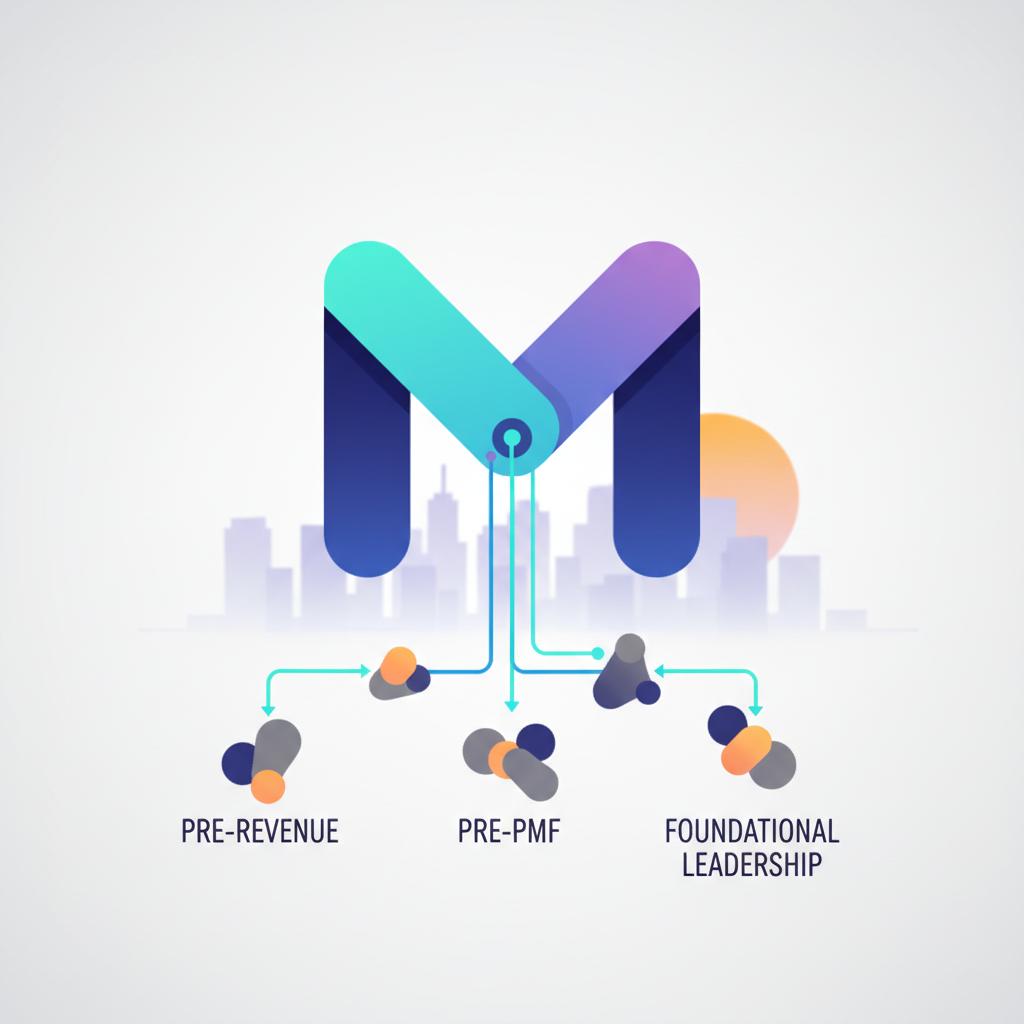
For most, marketing is synonymous with growth. It’s about acquiring users, generating leads, and driving revenue. But what is the role of marketing when there’s no product to sell, no revenue to track, and not even a clear market to target? This is the unique and often misunderstood world of the pre-revenue, pre-product-market-fit (pre-PMF) startup. In this phase, marketing isn't about scaling; it's about searching. It’s about laying a strategic foundation of market understanding that will determine whether the company ever reaches the growth stage at all.
This guide is for the founders and early-stage marketing leaders navigating this ambiguous territory. We'll explore how to build a marketing function from scratch, focusing on validation, discovery, and strategic positioning long before the first dollar is earned.
Defining the Seed-Stage CMO: Shifting from Growth to Discovery
The title 'Chief Marketing Officer' in a pre-PMF startup is a misnomer. The traditional CMO is a scaler, an optimizer of known channels and established funnels. The seed-stage marketing leader is a discoverer, an explorer charting a map of the market. Their primary role isn't demand generation; it's demand validation.
- Market Validation Over Lead Generation: The key responsibility is to answer fundamental questions: Does the problem we think we're solving actually exist? Is it a priority for our target audience? Are they willing to pay for a solution? The output of this work isn't MQLs; it's validated insights, customer personas, and a refined problem statement.
- Setting Expectations with Founders: Founders, often with a product-centric view, can expect immediate marketing ROI. The early-stage marketing leader must educate them on the 'long game.' Success isn't measured in website traffic or lead counts, but in the speed of learning and the reduction of market risk. This is about spending a little on research now to avoid wasting millions on building the wrong product later.
- The 'Growth Mindset' vs. the 'Brand Mindset': A resource-constrained environment pushes for a 'growth hacking' mindset. However, without a product, there's nothing to hack. Instead, a 'foundational brand mindset' is more valuable. This involves crafting the core story, defining the category, and building a narrative that will attract the first crucial believers—be they investors, beta users, or key hires. Hiring an experienced Fractional CMO for SaaS can be an effective way to bring this strategic leadership into an early-stage team without the commitment of a full-time executive salary.
Developing a Stealth Mode Startup Marketing Strategy
Being pre-launch doesn't mean being silent. A stealth mode strategy is about controlled, strategic communication designed to build anticipation and gather critical feedback without revealing your entire hand.
How do you market a secret? You market the problem, the vision, and the team.
- Founder-Led Brand Building: The founders are the first 'product.' They should be actively building their personal brands on platforms like LinkedIn and Twitter, not by talking about their secret product, but by becoming recognized experts on the problem space they aim to disrupt. They should be sharing insights, commenting on industry trends, and engaging with potential customers.
- Leveraging Gated Communities: Create a 'behind-the-scenes' feel. A simple landing page with a compelling headline and a form to 'request beta access' can be enough to start building a waitlist. This list is marketing gold—a pre-qualified group of early adopters eager to provide feedback.
- Strategic Use of One-on-One Relationships: Pre-PMF marketing is high-touch. It's about private conversations, DMs, and Zoom calls. Every interaction is an opportunity to validate an assumption and refine your messaging. Use NDAs when necessary, but prioritize building trust-based relationships where early adopters feel like co-creators.
Finding Product-Market Fit as a Marketing Leader
While Product and Engineering build the solution, Marketing's job is to own the 'market' side of product-market fit. This involves running a rigorous customer discovery process that directly informs the product roadmap.
Implementing a Customer Discovery Framework
This isn't about asking people if they'd use your hypothetical product. It's about deep, empathetic inquiry into their current workflows, pain points, and 'jobs to be done'. The marketing leader should be conducting dozens of these interviews, systematically logging and analyzing the findings. The goal is to test the 'problem-solution' fit before a single line of code is written for the final product.
Quantitative vs. Qualitative Data
At this stage, qualitative data is king. A single, hour-long customer interview is worth more than 10,000 website visits to a vague landing page. The signals that matter are the emotional ones: the frustration in a user's voice when describing a workflow, the excitement about a potential solution, the follow-up questions they ask. You're looking for recurring themes and powerful verbatim quotes that prove the pain is real.
Iterative Messaging Testing
Each customer interview is a chance to test your messaging. Start the call with one version of your one-line pitch. Note their reaction. Halfway through, try re-phrasing it based on what you've learned. By the end, ask them how they would describe the solution to a colleague. This iterative process, repeated over dozens of conversations, will forge a value proposition that resonates because it has been co-created with the market itself.
Validating Customer Segments: Data-Driven ICP Development
An Ideal Customer Profile (ICP) for a pre-revenue startup is a hypothesis, not a fact. Marketing's job is to run experiments to prove or disprove that hypothesis.
- Beyond Demographics: Don't just define your ICP by title or company size. Focus on psychographics and behaviors. Who is actively trying to solve this problem right now? Who is hacking together a solution with spreadsheets and duct tape? These are your 'Day Zero' adopters.
- Refining the ICP with Outreach Experiments: Use B2B prospecting tools to build small, targeted lists of different potential customer segments. Send them personalized outreach with slightly varied messaging. Don't measure success by meetings booked, but by reply sentiment. A reply that says, 'This isn't for me, but you should talk to our engineering department' is a hugely valuable data point that helps you refine your ICP.
- Mapping a Future Customer Journey: Even without a product, you can map the theoretical customer journey. What triggers would make them search for a solution like yours? Who would need to be involved in the decision? What would their 'aha' moment be? This a-priori journey map is a critical strategic asset that guides future content and funnel development.
The Early-Stage Startup Messaging Framework
Your story is your most valuable asset. Before you have a product, you have a narrative. This narrative needs to be compelling, consistent, and adaptable to different audiences.
- Focus on the 'Hero Use Case': Don't try to be everything to everyone. Identify the single most painful, most addressable use case for your theoretical product. Your entire initial messaging strategy should be built around this 'hero story.'
- Investors vs. Early Adopters: Your messaging needs two dialects. For investors, the story is about market size, defensibility, and team. For early adopters, it's about a specific, visceral pain point and a credible, albeit future, solution. The marketing leader must be fluent in both.
- Building a Modular Messaging House: Develop a core messaging document that can be broken down into different formats: a 10-second elevator pitch, a 300-word website copy block, a three-sentence cold outreach email. This ensures consistency while allowing for flexibility.
- Developing a Brand Voice: In a sea of pre-revenue startups, a distinct voice can be a major differentiator. Are you the academic expert, the scrappy rebel, the empathetic partner? This voice should be a reflection of the founders' values and should permeate every tweet, email, and landing page.
How to Build a Marketing Plan Before Product Launch
A pre-launch marketing plan is not about channels and campaigns. It’s about building assets, capabilities, and a strategic runway for launch.
- The 'Minimum Viable Stack': Avoid the temptation of a bloated martech stack. At this stage, you need a CRM (even a spreadsheet can work initially), a simple landing page builder, and basic analytics. A key early investment is B2B website visitor tracking software. Even on a simple waitlist page, knowing which companies are sniffing around provides invaluable early signals of interest.
- Allocating a Pre-Revenue Budget: Most of your budget should go toward learning, not advertising. This means allocating funds for customer interview incentives, user testing platforms, and perhaps a small, highly targeted PPC campaign aimed at validating messaging, not generating leads. When planning your leadership costs, using a Fractional CMO Calculator can help you understand the financial benefits of bringing in part-time executive experience.
- Milestone-Based Goals: Forget MQLs. Your goals should be milestone-based. Examples include: 'Complete 50 customer discovery interviews by Q2,' 'Achieve a 90% problem validation rate with our target ICP,' or 'Build a waitlist of 200 qualified beta users.'
- 'Big Bang' vs. 'Rolling Launch': The marketing plan should define the launch strategy. A 'Big Bang' requires building significant anticipation and coordinating PR and influencers for a single moment. A 'Rolling Launch' involves gradually letting users in from the waitlist, creating a more controlled feedback loop. The choice depends on the product, market, and the startup's risk tolerance.
Executing the First 90 Days: From Zero to Foundation
The first 90 days for a foundational marketing leader are a sprint of learning and building.
- Audit Everything: Start by performing a comprehensive audit of all existing assumptions. Interview the founders relentlessly. Why do they believe the market needs this? What evidence do they have? A formal SaaS Growth & Marketing Audit can provide a structured framework for this critical initial phase. Use a SaaS Marketing Assessment to benchmark current capabilities, even if they are nascent.
- Hiring Strategy: Your first 'hire' might be a freelancer to write content based on your customer interviews. An agency might be used for a specific, short-term project like a competitive analysis. Resist the urge to hire a full-time marketing manager until you have a validated, repeatable process for them to manage.
- Establish the Feedback Loop: The most important system to build is the feedback loop between the market (owned by Marketing), the product (owned by Product), and the technology (owned by Engineering). This could be a weekly insights meeting, a shared Slack channel, or a dedicated repository for customer feedback.
- Measure Success Differently: Success in the first 90 days is not revenue. It's the 'Cost Per Insight' and the 'Speed of Learning.' Are you invalidating bad ideas quickly and cheaply? Are you converging on a high-conviction ICP and value proposition? That is the ROI of foundational marketing.
Marketing before product-market fit is the ultimate strategic function. It's about navigating the fog of uncertainty with a compass of customer discovery and a map of strategic narrative. By focusing on validation overgrowth and learning over-earning, foundational marketing leaders don't just build a marketing plan; they build the very cornerstones of a successful business. Once that foundation is solid and PMF is achieved, the focus can shift to scaling with a powerful Sales Enablement Platform to equip the growing sales team. For now, continue your deep dive into strategy with this SaaS marketing book designed for founders and leaders.